AI-Driven Robotics: STM32 Sensor Fusion and ITTIA DB Lite AI Data Pipelines
Reliable Data Infrastructure for AI-Ready Robotics
Modern robotics systems are rapidly evolving from simple automation platforms into intelligent, autonomous machines powered by Edge AI. These robots continuously generate large volumes of sensor data and environmental sensors that must be collected, processed, and acted upon in real time.
The success of Edge AI in robotics depends not only on the quality of AI models but also on the ability to manage data reliably and deterministically at the edge. Effective data management enables robots to store time-series data, perform data cleansing and feature engineering, maintain historical context, support explainable AI decisions, and synchronize meaningful insights with fleet management systems. By combining Edge AI with robust data management, robotics manufacturers can create autonomous systems that are more reliable, adaptive, efficient, and capable of making intelligent decisions in dynamic real-world environments.
This device data allows robots to detect patterns, recognize anomalies, optimize movements, predict failures, adapt to changing environments, and improve operational efficiency over time. With Edge AI and robust data management, robots can transform raw sensor streams into actionable intelligence directly on the device, enabling more autonomous, reliable, and explainable behavior without constant cloud dependency. In this new generation of robotics, intelligence is created through the continuous flow of trusted data from sensing to learning, reasoning, and action.
Meanwhile, many microcontrollers, specially STM32 devices are rapidly evolving beyond traditional embedded control into intelligent edge computing platforms capable of real-time analytics, sensor fusion, robotics control, and Edge AI. As AI moves closer to the device, the challenge is no longer simply running inference models, it is building reliable, synchronized, and explainable data pipelines that continuously transform raw sensor signals into operational intelligence.
It is important to note that modern robotics and intelligent edge applications depend on multiple sensor streams operating simultaneously. Cameras, LiDAR, IMUs, motors, encoders, environmental sensors, and communication interfaces continuously generate large volumes of time-sensitive data that must be acquired, synchronized, processed, and analyzed in real time. Robotics applications depend on structured, synchronized, and explainable data pipelines that combine multiple sensor streams (camera, LiDAR, IMU, motors, etc.) into AI-ready features for autonomous decision making and real-time intelligence.
This is where AI-ready data pipelines and sensor fusion become critical for STM32-based systems. Sensor fusion allows STM32 devices to combine information from multiple sensors to create a more accurate and contextual understanding of the environment. For example:
- Cameras provide visual awareness
- IMUs provide motion and orientation
- LiDAR enables distance and spatial mapping
- Motor telemetry reveals operational behavior
- Environmental sensors provide surrounding conditions
When these data streams are synchronized and processed together, STM32 devices can support intelligent behaviors such as:
- Autonomous navigation
- Obstacle avoidance
- Predictive maintenance
- Motion stabilization
- Object detection
- Environmental awareness
- Human-machine interaction
However, AI models alone are not sufficient. The quality, timing, structure, and reliability of the data pipeline directly determine the accuracy and trustworthiness of Edge AI systems.
Modern STM32 applications therefore require embedded data infrastructure capable of:
- Deterministic sensor ingestion
- Real-time time-series data management
- Multi-stream synchronization
- AI-ready feature engineering
- Signal conditioning and filtering
- Reliable data persistence
- Power-fail-safe operation
- Low-latency analytics
- Explainable data lineage
- Concurrent sensor processing
AI-ready data pipelines continuously transform raw sensor signals into structured features suitable for inference engines such as STM32Cube.AI and CMSIS-NN. Data cleaning, normalization, lag analysis, rolling windows, filtering, and feature extraction can all be performed directly on STM32 devices at the edge.
For robotics applications, this enables real-time decision making directly on microcontrollers without relying entirely on cloud connectivity. STM32 systems can locally detect anomalies, understand motion patterns, estimate operational health, and respond autonomously with bounded latency and predictable behavior.
As robotics and Edge AI systems continue to evolve, STM32 devices are becoming intelligent sensor hubs where real-time data management, analytics, AI, and sensor fusion converge directly on highly resource-constrained hardware.
Robotics Data Challenges on Microcontrollers
Advanced robots increasingly rely on microcontrollers to perform real-time sensing, control, and Edge AI inference at the device level. However, these systems face significant data challenges. Robots continuously generate streams of data from motors, encoders, IMUs, cameras, force sensors, and environmental sensors that must be collected, processed, and stored within the limited memory, storage, and processing resources of an microcontroller. Without an effective data management strategy, developers often struggle with data loss, poor data quality, limited historical context, inefficient AI pipelines, and difficulty tracing decisions made by autonomous systems.
A data-centric approach addresses these challenges by providing deterministic time-series storage, data cleansing, feature engineering, and reliable data access directly on the microcontroller. With the ITTIA DB Platform which includes ITTIA DB Lite AI, robotics developers can transform raw sensor streams into structured, AI-ready data, enabling real-time analytics, explainable Edge AI, predictive maintenance, and intelligent robotic behavior while maintaining predictable performance and efficient resource utilization.
ITTIA DB Platform for STM32 Edge AI Systems
The ITTIA DB Platform provides a complete data infrastructure for building intelligent Edge AI applications on STM32 devices. By combining ITTIA DB Lite AI, ITTIA DB, ITTIA Analitica, and ITTIA Data Connect, developers can create end-to-end data pipelines that transform raw sensor data into actionable insights directly at the edge. ITTIA DB Lite AI enables deterministic data collection, time-series management, data cleansing, feature engineering, and AI-ready processing on STM32 microcontrollers.
ITTIA DB extends these capabilities to higher-performance embedded processors, providing robust and scalable data management. ITTIA Analitica delivers embedded analytics, visualization, and dashboards for monitoring system behavior and AI outcomes, while ITTIA Data Connect enables secure synchronization and selective sharing of data across devices, gateways, and cloud services. Together, the ITTIA DB Platform helps developers build reliable, explainable, and AI-ready STM32 solutions where data flows seamlessly from Sensor → Data Management → Feature Engineering → AI Inference → Analytics → Action, enabling smarter and more autonomous edge systems.
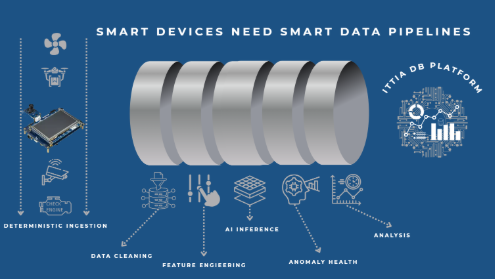
Unlocking the Full Potential of STM32 and Microcontrollers Based Edge AI
As STM32 devices and other modern microcontrollers continue to increase in performance, memory capacity, and AI capabilities, the challenge is no longer simply running AI models, it is managing the data that powers them.
The ITTIA DB Platform provides a complete data infrastructure for microcontroller-based Edge AI systems, enabling developers to efficiently collect, store, process, analyze, and synchronize data directly on the device. With ITTIA DB Lite AI, developers can implement deterministic time-series management, data cleansing, feature engineering, rolling-window analytics, and AI-ready data pipelines within the constraints of microcontroller environments. This allows STM32-based systems to maintain historical context, improve AI accuracy, support explainable decisions, and operate reliably even when disconnected from the cloud. By transforming raw sensor streams into structured, actionable intelligence, the ITTIA DB Platform helps developers accelerate development, reduce system complexity, improve reliability, and unlock the full value of Edge AI on resource-constrained devices.
Conclusion
As Edge AI moves onto STM32 devices and other microcontrollers, data management is becoming as important as the AI models themselves. The ITTIA DB Platform provides the data infrastructure needed to collect, manage, process, and transform sensor data into trusted intelligence directly at the edge. By enabling deterministic data management, AI-ready feature engineering, embedded analytics, and secure data exchange, ITTIA helps developers build more reliable, explainable, and intelligent microcontrollers-based systems. The result is faster development, improved AI performance, and smarter edge devices that can operate autonomously in real-world environments. Therefore, the future of embedded intelligence will not be defined solely by AI models or compute acceleration, but by how effectively STM32 devices acquire, synchronize, manage, trust, and operationalize sensor data in real time.
