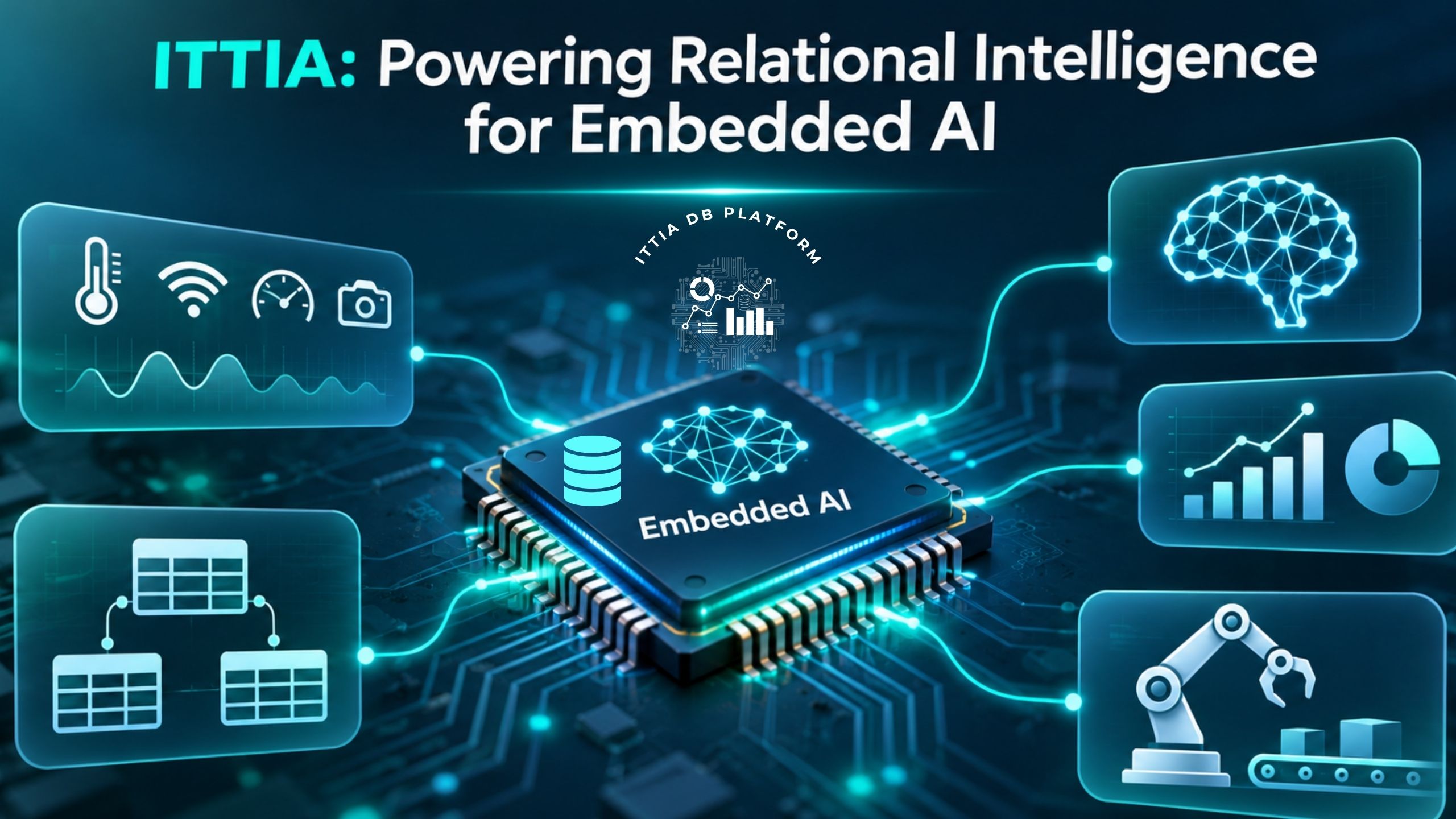
Powering Relational Intelligence for Embedded AI with ITTIA DB
Why the Relational Data Model Is Becoming Essential for Embedded AI
Introduction: Embedded AI Needs More Than Processing Power
Embedded systems are undergoing a fundamental transformation. Microcontrollers and microprocessors are evolving from devices that simply collect sensor measurements and execute predefined instructions into intelligent platforms capable of analyzing information, recognizing patterns, making decisions, and interacting with the physical world.
With the growing adoption of Embedded AI, Edge AI, and Physical AI, intelligent devices must do much more than execute neural-network models. They must continuously collect data, maintain historical information, process real-time measurements, generate meaningful features, and preserve the relationships between observations, AI inference results, and physical actions.
This introduces an important architectural question: How can embedded systems organize, manage, and understand the relationships between their data while operating under strict memory, processing, storage, and real-time constraints?
The answer increasingly involves the relational data model, a proven approach to managing structured information and the relationships between different types of data. Historically associated with enterprise databases and larger computing platforms, relational data management is becoming increasingly valuable inside embedded devices.
The ITTIA DB Platform, including ITTIA DB for microprocessors and ITTIA DB Lite and ITTIA DB Lite AI for microcontrollers, brings relational data management together with streaming, time-series processing, transactional integrity, and AI enablement directly to the edge.
The result is a data foundation that helps transform embedded devices from simple data collectors into intelligent systems capable of maintaining context, processing information, and supporting trustworthy decisions.
1. Why Traditional Embedded Data Management Is No Longer Sufficient
Traditional embedded software often manages data through C structures, arrays, buffers, files, and application-specific storage mechanisms. These approaches can be efficient when an application handles a limited amount of information and performs straightforward control operations. However, as embedded applications become more intelligent, their data-management requirements grow significantly.
Consider an industrial motor-monitoring system that continuously collects vibration, temperature, current, and rotational speed. A traditional application may store measurements in separate buffers and perform calculations using custom software routines. An Embedded AI application must go further.
It may need to correlate motor speed with vibration measurements, compare current operating conditions with historical behavior, generate RMS and FFT features, associate those features with an AI model version, and preserve the resulting anomaly prediction.
If a failure occurs, engineers may also need to determine which measurements, features, and operating conditions contributed to the decision. Without structured data management, developers must manually maintain these relationships across multiple software components.
This increases development complexity and creates opportunities for inconsistent records, incomplete historical information, duplicated data, and difficult-to-maintain application code. Embedded AI requires not only efficient data processing, but also a disciplined way to preserve the meaning, consistency, and relationships of information throughout the device's operational lifetime. This is where the relational model becomes particularly valuable.
2. What Makes the Relational Model Important for Embedded AI?
The relational data model organizes information into structured relations, commonly represented as tables, with defined attributes and relationships. Rather than treating each measurement as an isolated value, the relational model allows applications to connect different types of information through shared identifiers, timestamps, and logical constraints.
For example, an intelligent embedded device may maintain related information about:
- Devices and sensors: Device identity, configuration, calibration, and sensor characteristics.
- Historical measurements: Time-stamped temperature, vibration, current, pressure, and operational data.
- AI-ready features: Statistical values, rolling windows, RMS, FFT components, trends, and derived signals.
- AI models: Model identity, version, configuration, and deployment information.
- Inference results: Predictions, anomaly scores, confidence values, and classifications.
- Physical actions: Control commands, alarms, actuator responses, and resulting operating conditions.
The relational model allows these datasets to remain logically connected. This provides several important benefits.
Structured Historical Context
AI models frequently require more than the latest sensor measurement. They benefit from historical trends, operating conditions, and changes over time. Relational data management allows historical measurements to be associated with the sensors, devices, configurations, and operating states that produced them.
Data Integrity and Consistency
Relational constraints and transactional operations help maintain consistency across related records. For example, a stored inference result can reference the appropriate model version and feature set, reducing the risk of interpreting a prediction without its original context.
Efficient Data Access and Analysis
Structured queries and relational access methods help applications retrieve related information without repeatedly implementing custom filtering and correlation logic.
AI Traceability and Observability
By preserving relationships between measurements, features, models, inferences, and actions, embedded systems can provide useful evidence for debugging, validation, and analysis.
Easier Software Evolution
As developers add sensors, introduce AI models, or expand application capabilities, structured data models can reduce the complexity of adapting existing software. The relational model transforms isolated embedded data into organized information with relationships, historical context, and operational meaning.
3. Why Relational Data Management Matters for Physical AI
Physical AI introduces an additional level of complexity because intelligent systems must interpret information and take actions that influence real-world processes. An autonomous robot, intelligent battery controller, industrial machine, or medical device may use AI inference to influence motors, actuators, charging operations, alarms, and other physical activities.
A typical Physical AI application collects sensor measurements, organizes historical information, generates features, executes AI inference, determines appropriate actions, and records the results. Each stage depends on the quality and consistency of the information produced by earlier stages. The relational model provides a structured way to preserve connections across this process.
Consider an intelligent robotic system that detects an abnormal increase in motor vibration. A relational data foundation can help connect the anomaly to the motor's operating speed, temperature, vibration history, feature values, AI model version, inference result, and subsequent corrective action.
This makes it possible to answer important questions:
- What operating conditions existed when the anomaly occurred?
- Which historical measurements contributed to the prediction?
- Which features were provided to the AI model?
- Which model version generated the inference?
- What action did the device take?
- Did that action improve operating conditions?
These capabilities are particularly valuable for predictive maintenance, intelligent robotics, autonomous equipment, battery management, and safety-conscious embedded applications. For Physical AI, the relational model helps connect what a device observes, what it learns from its data, what it decides, and what it ultimately does in the physical world.
4. ITTIA DB Lite: Bringing Relational Data Management to Microcontrollers
Microcontrollers present some of the most demanding data-management environments. They frequently operate with limited RAM, constrained flash storage, strict execution deadlines, and demanding power requirements.
Historically, these limitations encouraged developers to avoid relational databases and instead implement custom storage structures. However, modern intelligent microcontrollers increasingly need structured historical data, transactional updates, and AI-ready processing.
ITTIA DB Lite brings relational data management to resource-constrained microcontrollers through an architecture designed for real-time embedded applications.
Its capabilities include:
- Lightweight Relational Data Modeling: Developers can organize device configuration, sensor information, operational records, and application state into structured data models rather than maintaining unrelated files and buffers.
- SQL-Based Data Modeling: ITTIA DB Lite supports defining relational schemas through SQL and generating specialized C/C++ interfaces suitable for MCU firmware, allowing relational development techniques without requiring the same execution architecture as a large enterprise database.
- Deterministic Streaming and Data Processing: Continuous sensor measurements can be ingested, processed, queried, and selectively retained under embedded resource constraints.
- Integrated Time-Series Management: Time-stamped measurements can be organized into historical datasets for real-time analysis, trends, and event correlation.
- Transactional Integrity: Related updates can be managed consistently, reducing the risks associated with partially completed operations.
- Power-Fail Recovery: Crash-consistent persistence helps protect committed database information during unexpected resets and power interruptions.
- Flash-Aware Storage: Efficient storage and retention strategies help reduce unnecessary flash operations and manage endurance limitations.
These capabilities are particularly relevant for Arm Cortex-M microcontrollers, including STM32 and other embedded MCU platforms.
Rather than forcing developers to choose between lightweight embedded execution and structured data management, ITTIA DB Lite provides a foundation that combines these requirements. The significance is not simply bringing relational concepts to microcontrollers. It is making structured, consistent, and historically meaningful data practical for intelligent MCU applications.
5. ITTIA DB Lite AI: Extending Relational Data into AI-Ready Intelligence
While ITTIA DB Lite provides the embedded data-management foundation, ITTIA DB Lite AI extends that foundation toward the requirements of AI-enabled microcontrollers. AI inference models typically require carefully prepared input features rather than unprocessed sensor measurements.
These features may include rolling averages, RMS values, variance, minimums and maximums, lag and delta measurements, rate of change, time-window statistics, normalization, and frequency-domain information.
Relational data management adds value by helping connect feature values with their original measurements, timestamps, processing windows, and operating conditions.
For example, a motor-health application may calculate vibration features over successive time windows. Instead of treating each result as an isolated number, the application can associate the feature with its source sensor, sampling interval, motor operating speed, and subsequent AI inference. ITTIA DB Lite AI supports this transition through structured data processing, historical context, and AI-oriented feature engineering.
This provides several advantages:
- Consistent AI Inputs: Structured measurements and processing windows can help produce repeatable feature-generation workflows.
- Historical Feature Context: AI applications can compare current features with previous operating conditions.
- Local Data Processing: Features can be generated directly on the device, reducing unnecessary movement of raw data to external systems.
- Inference Traceability: Applications can preserve associations between measurements, derived features, model versions, and inference results.
- Reduced Application Complexity: Developers can rely on integrated data-management capabilities rather than maintaining extensive custom data-processing infrastructure.
This does not eliminate the need for dedicated AI inference frameworks or optimized signal-processing libraries. Instead, ITTIA DB Lite AI complements these technologies by providing the persistent data foundation and historical context surrounding AI computation. AI engines perform inference. ITTIA DB Lite AI helps organize, process, and preserve the information that makes inference useful, traceable, and dependable.
static const db_aggregate_field_t aggr_fields[] = {
   { kBatteryRawStreamCellId,
     DB_AGGREGATE_GROUP_BY, "cell_id"      },
   { -1,
     DB_AGGREGATE_END_TIMESTAMP, "sample_time"  },
   { kBatteryRawStreamPowerW,
     DB_AGGREGATE_SUM, "energy_delta" },
   { kBatteryRawStreamVoltageV,
     DB_AGGREGATE_AVERAGE, "avg_voltage"  },
   { kBatteryRawStreamCurrentA,
     DB_AGGREGATE_AVERAGE, "avg_current"  },
   { kBatteryRawStreamTemperatureC,
     DB_AGGREGATE_AVERAGE, "avg_temp"     },
   { kBatteryRawStreamDurationSec,
     DB_AGGREGATE_AVERAGE, "duration_sec" },
};

status = db_stream_create_aggregates(
   &aggregate_node,
   window_node,
   aggr_fields,
   DB_ARRAY_DIM(aggr_fields));
6. ITTIA DB: Advanced Relational Data Management for Microprocessors
Microprocessors typically provide greater memory capacity, processing power, storage, and operating-system functionality than conventional microcontrollers. This enables more sophisticated relational queries, larger historical datasets, concurrent applications, advanced analytics, and more complex AI workloads. ITTIA DB is designed for embedded microprocessors and multicore systems requiring integrated relational, transactional, streaming, and time-series data management.
On platforms such as STM32MP1, STM32MP2, NXP i.MX, and NXP S32G, ITTIA DB can provide a richer relational foundation for intelligent embedded applications. Its value includes several important areas.
SQL and Relational Queries
Developers can retrieve, filter, join, aggregate, and correlate information across related datasets.
For example, a predictive maintenance application can correlate motor vibration measurements with operating speed, temperature history, maintenance events, and previous fault classifications.
Integrated Time-Series and Relational Data
Traditional relational information and continuous sensor history can be managed together. This is particularly valuable when AI applications need to understand both what happened and under which operating conditions it happened.
Transactional Consistency
Complex embedded applications may update multiple records representing device state, event history, application configuration, and AI results. Transactional data management helps preserve consistency between these records.
AI Feature and Inference Management
Structured relationships can associate processed data, AI features, model configurations, and inference results. This enables more meaningful diagnostics and historical analysis.
Vector and Multimodal Data Integration
For AI workloads involving embeddings, similarity search, image metadata, audio information, or sensor-derived feature vectors, relational modeling can connect those representations to devices, events, and historical records.
Where supported and appropriately configured, vector-oriented capabilities can complement relational queries by allowing applications to retrieve similar operating conditions or previous observations.
Local Data Ownership and Security
Processing and storing information on embedded microprocessors allows manufacturers to retain greater control over sensitive operational data while reducing reliance on continuous cloud connectivity.
The result is an embedded data architecture capable of supporting both real-time device operations and higher-level AI analytics. ITTIA DB brings together relational structure, SQL, time-series history, and AI-related information management to support intelligent embedded systems that require more than simple storage.
CSELECT cell_id,
       SUM(voltage_V * current_A * 1.0) AS energy_delta,
       AVG(voltage_V) AS avg_voltage,
       AVG(current_A) AS avg_current,
       AVG(temperature_C) AS avg_temp,
       CAST(INTERVAL '3' SECOND AS FLOAT32) AS duration_sec
 FROM battery_raw_stream
 FOR SYSTEM_TIME ALL
 WINDOW INTERVAL '3' SECOND
 SLIDE INTERVAL '3' SECOND
 GROUP BY cell_id
7. Microcontrollers and Microprocessors: One Relational Data Strategy, Different Resource Requirements
Microcontrollers and microprocessors perform different roles in intelligent embedded architectures. An MCU may continuously acquire sensor measurements, perform local feature engineering, and execute real-time AI inference.
An MPU may coordinate multiple devices, manage larger historical datasets, execute more sophisticated analytics, and support observability or gateway functionality. The relational model offers value in both environments, but its implementation must reflect the available resources and application requirements.
Capability | ITTIA DB Lite / DB Lite AI for MCUs | ITTIA DB for MPUs |
Relational data modeling | Lightweight structured schemas | Rich relational schemas |
SQL capabilities | Schema definition and embedded data interfaces | Advanced SQL querying and relational analysis |
Streaming | Deterministic local ingestion and processing | High-throughput and concurrent processing |
Time-series | Resource-efficient sensor histories | Larger historical datasets and analytics |
AI features | On-device feature engineering | Advanced analytics and feature correlation |
AI traceability | Local inference and feature context | Multi-source inference and event relationships |
Data integrity | Transactional updates and power-fail recovery | Transactional consistency and resilient storage |
AI data relationships | Resource-conscious associations | Richer relational, time-series, and vector-oriented workloads |
The objective is not to reproduce a full microprocessor database on a microcontroller. It is to provide a consistent data-management philosophy that scales from constrained sensing devices to more capable intelligent edge systems. This enables manufacturers to preserve application data relationships as their products evolve.
8. Why Relational Models Are Valuable for Predictive Maintenance, Robotics, Medical Devices, and Energy Systems
Predictive Maintenance
Industrial equipment generates vibration, temperature, current, pressure, and operational measurements. The relational model connects these measurements with equipment identities, maintenance records, feature histories, and anomaly predictions. This helps engineers identify operating patterns associated with developing faults and evaluate the effectiveness of corrective actions.
Intelligent Battery Management
Battery systems must correlate voltage, current, temperature, charging conditions, cell identities, and historical state estimates. Relational data management helps preserve the relationships required for state-of-charge, state-of-health, and remaining-useful-life analysis.
Robotics and Autonomous Systems
Robotic applications may need to correlate sensor observations, actuator commands, AI predictions, device configurations, and recorded outcomes. A relational foundation supports traceability and structured historical analysis, although safety-critical control must independently validate the device's physical state before acting.
Intelligent Medical Devices
Medical devices may require reliable relationships between measurements, operating parameters, alarms, user actions, and device events. Transactional relational data management can support data integrity, traceability, and engineering validation.
Agricultural and Environmental Monitoring
Smart agriculture and environmental devices must correlate sensor measurements with location, operating conditions, weather patterns, equipment states, and historical trends. A relational model supports structured analysis and intelligent decisions without requiring all raw information to be sent to cloud systems.
Across these industries, the value is consistent: Relational data management helps embedded AI systems understand the context of their information rather than processing each measurement independently.
9. Relational Data Management Enables Better AI Observability
As AI-driven embedded devices become more autonomous, manufacturers increasingly need to understand how their systems behave after deployment. A prediction or anomaly score is only one part of the story.
Engineers may need access to the underlying historical measurements, feature transformations, model versions, operating conditions, and physical outcomes. The relational model supports this requirement by maintaining explicit associations between these records.
The broader ITTIA DB Platform extends this value through ITTIA Analitica and ITTIA Data Connect. ITTIA Analitica provides visualization and observability of device information, helping developers examine live and historical data, analyze operational behavior, and investigate AI-related events.
ITTIA Data Connect supports selective data exchange and synchronization between microcontrollers, microprocessors, gateways, and connected systems. Together, these technologies can help manufacturers maintain local intelligence while making selected information accessible for development, diagnostics, fleet analysis, and continuous improvement.
Relational data becomes especially valuable when the information generated by intelligent devices must remain understandable after an AI decision has already been made.
10. Why Relational Data Management Can Reduce Embedded AI Development Cost
AI-assisted programming is making it easier for developers to generate software, build applications, and implement database-related functions. However, generating code does not automatically provide a validated embedded data architecture.
Developers must still address memory limits, flash endurance, concurrency, transactional consistency, power interruptions, timing requirements, security, and long-term maintenance. Implementing and verifying these capabilities from scratch can require significant engineering resources.
The ITTIA DB Platform helps address these challenges by providing an established embedded data-management foundation. Rather than repeatedly developing custom storage routines, data relationships, recovery procedures, and historical processing mechanisms, developers can build on an integrated platform.
ITTIA's engineering consultancy further supports this process through architecture reviews, schema design, platform integration, performance characterization, flash optimization, recovery testing, and AI data-pipeline development.
This combination is especially valuable for manufacturers seeking to move from experimental AI prototypes to production-ready embedded products. AI can accelerate software creation, while ITTIA helps reduce the complexity and risk of making that software dependable throughout the device's commercial lifetime.
Conclusion: The Relational Model Is Becoming a Foundation for Intelligent Embedded Systems
Embedded AI is fundamentally changing how microcontrollers and microprocessors manage information. Intelligent embedded devices are no longer expected simply to collect sensor data, execute algorithms, and produce immediate outputs.
They must increasingly preserve historical context, correlate multiple sources of information, prepare AI-ready features, execute inference models, record decisions, and understand the outcomes of physical actions.
The relational model offers a powerful foundation for addressing these requirements by organizing information into structured datasets and preserving the relationships that give data its meaning.
For resource-constrained microcontrollers, ITTIA DB Lite brings lightweight relational data management, deterministic streaming, time-series processing, transactional integrity, and power-fail recovery directly into embedded applications.
ITTIA DB Lite AI extends this foundation with feature engineering, historical context, and AI-ready data processing, enabling intelligent MCU applications to connect sensor information with inference results.
For more capable microprocessors, ITTIA DB provides richer relational and SQL capabilities, integrated time-series analytics, transactional processing, and support for increasingly sophisticated embedded AI workloads.
Together with ITTIA Analitica and ITTIA Data Connect, the ITTIA DB Platform helps manufacturers build intelligent systems that preserve data relationships from individual sensing devices to complex microprocessor-based applications.
The future of Embedded AI is not simply about running more powerful AI models. It is about ensuring that those models operate on structured, consistent, reliable, and historically meaningful information.
Discover the Possibilities with the ITTIA DB Platform
Are you developing an intelligent embedded device that requires structured sensor data, historical analysis, feature engineering, reliable data persistence, or traceable AI inference?
We invite you to connect with ITTIA's embedded engineering experts to explore how relational data management can strengthen your application architecture.
Our team can help evaluate your microcontroller or microprocessor platform, memory and flash constraints, sensor interfaces, sampling rates, real-time requirements, data relationships, SQL and query needs, and AI integration plans.
Whether your application involves robotics, predictive maintenance, battery management, intelligent medical devices, industrial automation, or other Physical AI systems, ITTIA can help you establish a dependable data foundation for long-term product development.
ITTIA DB Platform - Connecting Embedded Data, Historical Intelligence, and Physical AI Through Reliable Relational Data Management.
