Why Feature Engineering and AI Preparation Matter for Physical AI in Robotics
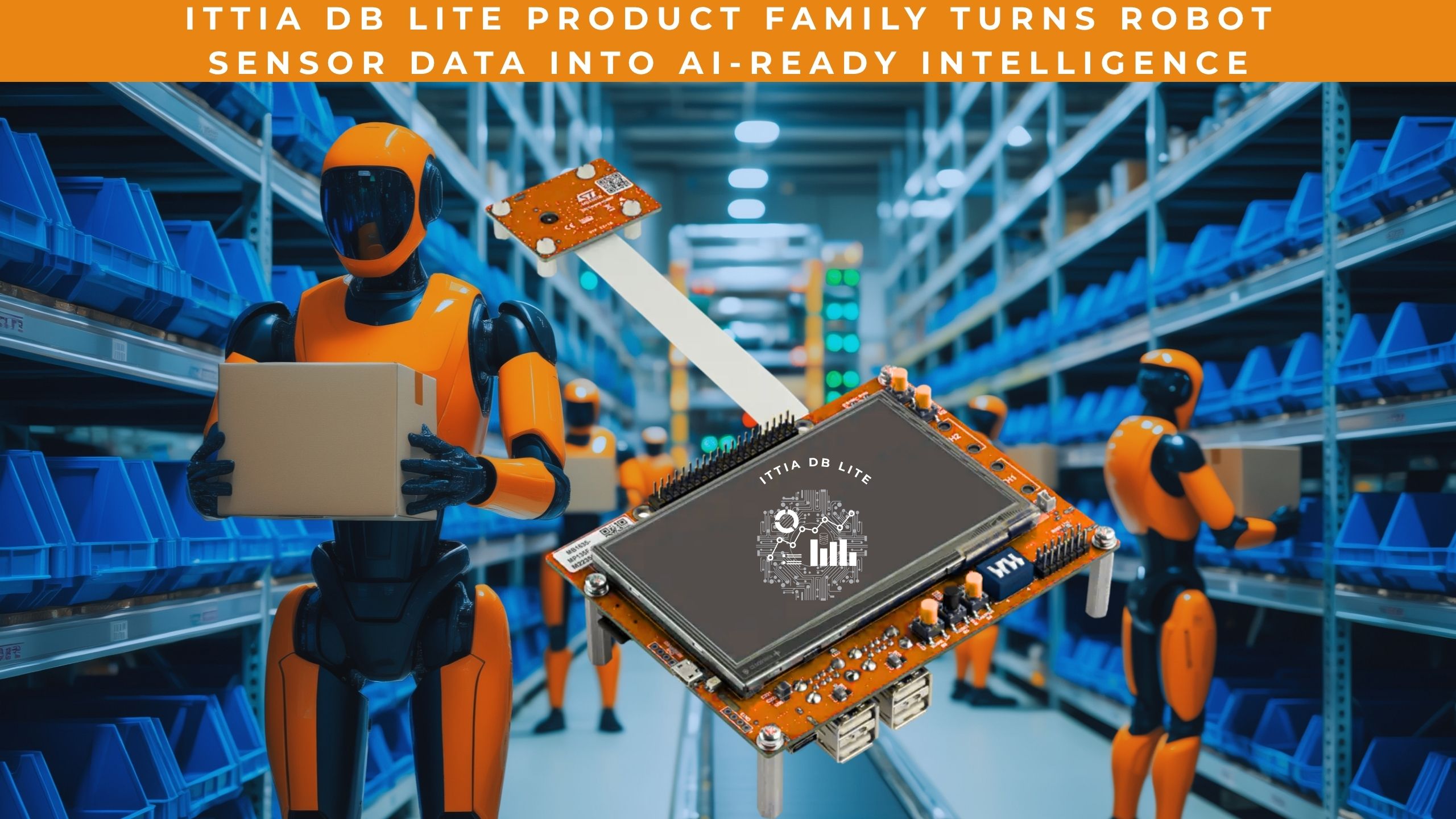
ITTIA DB Lite Product Family Turns Robot Sensor Data into AI-Ready Intelligence
Modern robots are becoming increasingly autonomous, adaptive, and intelligent. They continuously collect information from motors, encoders, force sensors, IMUs, cameras, microphones, temperature sensors, current sensors, proximity sensors, and other sources that describe both the robot and the physical environment around it.
But raw robotic sensor data alone is rarely sufficient for AI. Before a robot can use that information for inference, control, anomaly detection, predictive maintenance, navigation, or intelligent physical action, the data often needs to be organized, aligned, processed, and transformed into meaningful features.
The ITTIA DB Lite Product Family, including ITTIA DB Lite and ITTIA DB Lite AI, provides the on-device data foundation needed to transform continuous robot data into structured, contextual, and AI-ready information.
Robot Data Must Become Meaningful Information
A robot may generate large volumes of data every second from motor current, position, velocity, force, vibration, temperature, motion, and vision-derived features. Simply collecting these measurements does not make them useful for AI.
For example, motor-current data may need to be converted into trends or rates of change. Vibration signals may need RMS, variance, FFT components, or frequency-band energy. Motion data may need filtering, normalization, or rolling statistics. Force and position data may need to be correlated to understand contact, resistance, or mechanical behavior.
The ITTIA DB Lite Product Family helps create an on-device robotics pipeline that transforms raw robot data into structured information, processes it into meaningful features, prepares AI-ready inputs, and supports real-time inference directly inside the robot.
Feature Engineering Close to the Robot
Feature engineering converts raw robotic measurements into information that better represents physical behavior. For example, a robotic actuator may produce thousands of motor-current and position samples. Rather than feeding every sample directly into an AI model, the embedded system may calculate: RMS, variance, rolling averages, rate of change, lag, delta, FFT components, frequency-band energy, normalization, interpolation, and other derived features.
These features can reveal patterns such as:
- Increasing actuator friction
- Abnormal vibration
- Unexpected load
- Mechanical wear
- Motion instability
- Contact anomalies
- Changes in motor behavior
By performing feature engineering close to where the data is generated, the robot can create useful AI inputs without continuously moving large volumes of raw data elsewhere.
Real-Time AI Preparation for Autonomous Robots
Robots operate in environments where conditions can change within milliseconds. A robotic arm may encounter unexpected resistance. An autonomous mobile robot may experience wheel slippage. A motor may begin vibrating abnormally. A gripper may detect an unexpected force. A humanoid robot may need to adjust balance based on changing motion data. These situations require data to be processed while the physical event is occurring.
The ITTIA DB Lite Product Family enables a robotics data pipeline that moves from robot sensors through windowing, processing, and feature engineering to AI inference, intelligent robot decisions, and physical action directly within the embedded platform.
Historical Context Gives Robots Memory
Robotic intelligence becomes more valuable when the system can understand not only the current condition but also how that condition developed over time. A motor temperature of 70°C may be acceptable under one workload and abnormal under another.
An increase in current may indicate a heavier payload, or it may be an early sign of actuator wear. A vibration spike may be harmless if it occurs during a known movement, but significant if it occurs repeatedly during normal operation. Historical data helps distinguish these situations.
The ITTIA DB Lite Product Family can maintain current measurements alongside historical operating data, enabling robotic AI applications to compare present behavior with previous motion patterns, motor loads, temperature trends, maintenance events, anomalies, AI results, and physical outcomes.
Streaming data provides awareness, historical data provides memory, feature engineering creates understanding, and AI turns that understanding into inference.
Multimodal AI Preparation for Robotics
Robots rarely depend on a single sensor and instead combine multiple data sources to understand both their own operating condition and the surrounding environment. A robotic arm may use joint position, motor current, force, vibration, and temperature; an autonomous mobile robot may combine IMU data, wheel speed, motor current, distance sensors, and environmental information; a humanoid robot may rely on motion, force, balance, joint position, and vision-derived features; and a robotic gripper may use force, position, current, and contact events.
Because these signals often arrive at different rates and from different subsystems, the ITTIA DB Lite Product Family helps align and organize multimodal data around timestamps, robot state, operating mode, events, and historical context, creating a more complete representation of what the robot is experiencing and giving AI models richer information for understanding physical conditions, making better inferences, and supporting intelligent action.
Reduce the AI Processing Burden
Embedded robotic systems operate within limited compute, memory, power, and bandwidth. Feeding every raw sensor sample directly into an AI model may be inefficient or unnecessary.
Feature engineering transforms high-volume raw robotic data into compact, meaningful AI features such as RMS, rate of change, and FFT components. These reduce the processing burden on AI models while lowering CPU workload, RAM usage, storage requirements, data movement, and power consumption, which is especially important for resource-constrained robotic controllers.
Feature Engineering for Robot Health and Predictive Maintenance
Feature engineering helps robotic systems combine changes in motor current, vibration, temperature, and position error with historical behavior to identify developing conditions such as friction, bearing wear, or mechanical misalignment, enabling a workflow from robot sensor data to feature engineering, historical comparison, AI inference, and predictive maintenance decisions.
Preparing Training Data from Real Robot Operation
The most valuable AI training data often comes from real-world robot operation. The ITTIA DB Lite Product Family can help preserve:
- Raw sensor measurements
- Robot operating state
- Motion and actuator data
- Derived features
- Anomaly events
- AI inference results
- Robot decisions
- Physical actions
- Final outcomes
By connecting sensor observations, robot state, events, actions, outcomes, and labels, the ITTIA DB Lite Product Family helps turn real-world robot experience into valuable training data that can improve AI models, validate algorithms, and enable new intelligent capabilities.
AI Observability for Intelligent Robots
As robots become more autonomous, developers need greater visibility into what the robot observed, what historical context was available, which features were generated, what inference was produced, what decision was made, what physical action followed, and what outcome resulted.
The ITTIA DB Lite Product Family preserves the complete AI decision chain from observation and historical context through feature generation, inference, decision, robot action, and outcome.
By maintaining the relationship between physical-world data, AI processing, decisions, and actions, developers gain a clearer understanding of why the robot behaved a certain way.
This creates a strong foundation for AI observability, diagnostics, validation, traceability, and continuous improvement, helping robotic systems become more understandable, reliable, and intelligent over time.
Designed for Resource-Constrained Robotic Controllers
Many robots rely on multiple embedded processors and microcontrollers for motor control, sensing, communications, safety functions, and local AI, often within tight limits on RAM, flash, CPU resources, power, storage endurance, and communications bandwidth. Their data and AI pipelines therefore must be designed for embedded environments rather than cloud infrastructure. The ITTIA DB Lite Product Family provides embedded data management and processing capabilities that operate close to robotic control workloads while supporting persistence, historical context, real-time processing, feature engineering, and AI preparation directly on the device.
Physical AI in robotics requires more than sensors, processors, and AI models. A robot needs a reliable data foundation that can transform continuous physical-world observations into structured, contextual, and AI-ready information. The ITTIA DB Lite Product Family helps create this foundation by connecting the physical environment and robot sensors to data management, processing, feature engineering, AI-ready information, inference, robot decisions, physical actions, and recorded outcomes.
By combining embedded data management, historical context, real-time processing, and feature engineering, the ITTIA DB Lite Product Family helps robots move beyond simply collecting sensor data toward understanding physical conditions, making intelligent decisions, acting autonomously, and learning from real-world outcomes. Intelligent robots need more than AI models; they need the right data, prepared in the right way, at the right time.
Discover the Possibilities with ITTIA DB Lite
Are you developing an embedded or intelligent device that needs to transform raw sensor data into meaningful, AI-ready features? We invite you to connect with ITTIA experts to explore how the ITTIA DB Lite Product Family can help bring data management, real-time processing, historical context, and feature engineering directly into your microcontroller-based application.
Our team can review your device architecture, sensor data, sampling rates, processing windows, memory and storage constraints, and AI integration requirements, and demonstrate how ITTIA DB Lite can help turn continuous physical-world data into structured information and useful features such as RMS, variance, rolling statistics, rate of change, FFT components, normalization, interpolation, and other AI-ready representations.
By performing feature engineering close to where the data is generated, the ITTIA DB Lite Product Family can help reduce unnecessary data movement, improve AI efficiency, preserve historical context, and create a more direct path from sensor data to feature generation, AI inference, intelligent decisions, and physical action.
