Data Management for TensorFlow Lite and LiteRT
Building Modern Edge AI Applications with ITTIA DB Lite AI and TensorFlow Lite
Artificial Intelligence is rapidly moving out of the cloud and into embedded devices. From industrial sensors and battery management systems to smart meters, medical devices, robotics, and intelligent vehicles, today's products are expected to analyze data and make decisions in real time without depending on cloud connectivity.
TensorFlow Lite is a lightweight machine learning inference framework designed to bring artificial intelligence to embedded and edge devices with limited processing power, memory, and energy consumption. Optimized for microcontrollers, embedded processors, and mobile platforms, TensorFlow Lite enables developers to deploy trained AI models that perform real-time inference directly on the device, eliminating the need for constant cloud connectivity.
By supporting efficient execution of tasks such as anomaly detection, predictive maintenance, image recognition, audio classification, and sensor analytics, TensorFlow Lite allows intelligent systems to make fast, low-latency decisions while improving privacy, reducing communication costs, and increasing system reliability. Its small footprint and optimized runtime make it an ideal AI engine for modern Edge AI applications running on resource-constrained embedded hardware.
The runtime can be configured to include only the operators required by a specific model, minimizing Flash usage while maintaining efficient execution. Depending on the model architecture and optimization techniques such as quantization, TensorFlow Lite can operate within a few hundred kilobytes of Flash and RAM, making it suitable for microcontrollers and embedded processors. Its lightweight design enables real-time inference with low latency and low power consumption, allowing developers to deploy AI applications such as anomaly detection, predictive maintenance, battery health estimation, image recognition, and sensor classification directly on edge devices without relying on cloud connectivity.
TensorFlow Lite was developed by Google as part of the TensorFlow project to enable machine learning inference on mobile, embedded, and IoT devices. TensorFlow Lite and LiteRT are essentially the same technology. Google renamed TensorFlow Lite to LiteRT in 2024 to reflect that the runtime is no longer limited to TensorFlow models and can efficiently run models originating from multiple frameworks.
For embedded developers, TensorFlow Lite (now LiteRT) has become one of the most widely adopted inference runtimes because it provides:
- Small Flash and RAM footprint
- Optimized inference for Arm Cortex-M and Cortex-A processors
- INT8 quantization support
- Hardware acceleration for NPUs, DSPs, and GPUs
- Efficient on-device inference without cloud connectivity
ITTIA DB Lite AI integrate with TensorFlow Lite, providing deterministic data acquisition, persistent time-series management, and feature engineering before passing AI-ready data to the inference engine.
ITTIA DB Lite AI is a deterministic embedded data platform designed to provide the complete data foundation for modern Edge AI applications running on microcontrollers and resource-constrained devices. It enables developers to acquire, manage, process, and preserve time-series sensor data while generating AI-ready features for real-time inference engines such as TensorFlow Lite.
By integrating persistent data management, streaming analytics, feature engineering, event detection, and power-fail-safe storage into a single lightweight solution, ITTIA DB Lite AI transforms raw sensor measurements into trusted operational intelligence. It also preserves historical context, inference results, and operational events, enabling explainable AI, predictive maintenance, and long-term system optimization. Rather than serving as only a database, ITTIA DB Lite AI acts as the data infrastructure layer that bridges embedded data acquisition with reliable, production-ready Edge AI.
At the heart of this transformation is TensorFlow Lite, which enables machine learning models to run efficiently on resource-constrained embedded processors. But while TensorFlow Lite provides the inference engine, it does not solve one of the most critical challenges in Edge AI, managing the data that feeds those models. This is where ITTIA DB Lite AI delivers tremendous value.
Together, ITTIA DB Lite AI and TensorFlow Lite create a complete Edge AI platform that enables developers to acquire, manage, process, and preserve operational data while delivering fast, reliable, and explainable AI directly on embedded devices.
Enabling Real-Time Inference with ITTIA DB Lite AI and LiteRT
Real-time inference is the process of executing a trained AI or machine learning model immediately as new data is generated, enabling an embedded device to make decisions with very low latency and without relying on cloud connectivity.
In an Edge AI system, sensors continuously collect data such as voltage, current, temperature, vibration, or images. This data is processed into AI-ready features and then passed to an inference engine such as TensorFlow Lite or LiteRT. The inference engine evaluates the data and produces a prediction or classification within milliseconds, allowing the device to respond immediately.
Typical real-time inference workflow 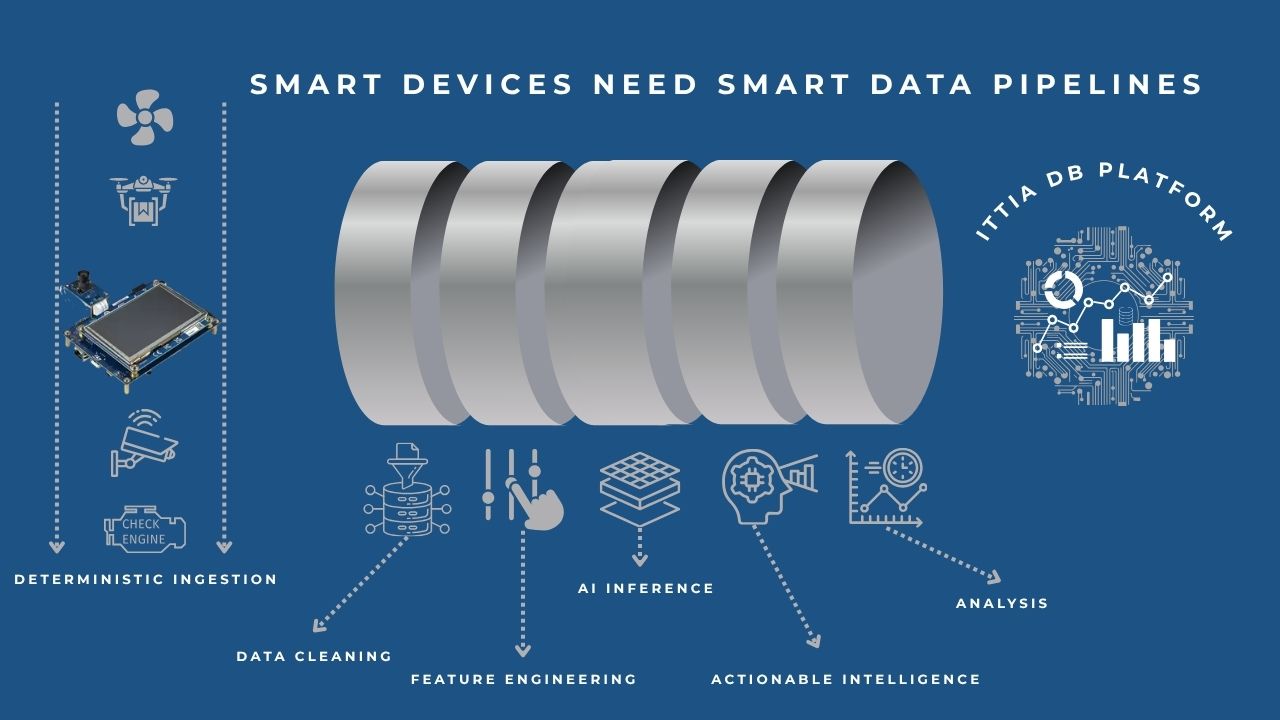
Examples
Battery Management System (BMS)
- Inputs: Voltage, current, temperature
- Real-time inference:
- Estimate State of Health (SoH)
- Predict Remaining Useful Life (RUL)
- Detect abnormal battery behavior
- Action: Alert the controller or adjust charging/discharging parameters.
Industrial Motor Monitoring
- Inputs: Vibration, current, temperature
- Real-time inference:
- Detect bearing wear
- Predict motor failure
- Classify operating conditions
- Action: Schedule maintenance before a failure occurs.
Medical Devices
- Inputs: ECG, blood pressure, oxygen saturation
- Real-time inference:
- Detect abnormal heart rhythms
- Identify physiological anomalies
- Action: Notify clinicians or trigger alarms immediately.
Characteristics of real-time inference
- Low latency: Predictions are generated in milliseconds or microseconds.
- Deterministic execution: The system consistently meets timing deadlines.
- On-device processing: No cloud connection is required.
- Low power consumption: Optimized for embedded processors and microcontrollers.
- Continuous operation: Processes streaming sensor data as it arrives.
Real-time inference is only one part of an Edge AI application. While TensorFlow Lite or LiteRT performs the AI computation, ITTIA DB Lite AI provides the deterministic data infrastructure that ensures the inference engine always receives the right data at the right time. It continuously acquires streaming sensor data, stores persistent time-series information, performs real-time feature engineering, and delivers AI-ready features to the inference engine with predictable latency.
After inference, ITTIA DB Lite AI preserves the prediction, confidence score, model version, timestamps, and historical operating conditions, creating a complete and explainable record of every AI decision. By managing the entire data lifecycle, from sensor acquisition to feature generation, inference integration, and decision traceability, ITTIA DB Lite AI transforms TensorFlow Lite or LiteRT from a standalone inference engine into a production-ready Edge AI solution capable of reliable, deterministic, and explainable operation in embedded systems.
Role of ITTIA DB Lite AI
Real-time inference depends on more than just the AI model. The system must reliably acquire, process, and deliver data to the inference engine. ITTIA DB Lite AI provides this foundation by deterministically acquiring sensor data, managing persistent time-series data, performing real-time feature engineering, preserving historical operating conditions, and recording inference results with timestamps, confidence scores, and model versions. This enables TensorFlow Lite or LiteRT to make fast, accurate, and explainable decisions while maintaining complete operational traceability.
Edge AI Begins with Data
Every intelligent embedded device continuously generates operational data from sensors, actuators, communication buses, and control systems, including measurements such as temperature, pressure, current, voltage, vibration, flow, humidity, accelerometer and gyroscope readings, motor speed, and battery health. However, raw sensor data alone is not suitable for AI inference. Before it can be used by a machine learning model, the data must be accurately acquired, validated, time-aligned, organized into time-series structures, processed, and transformed into meaningful features that reflect the true operating condition of the system. This data pipeline ensures that AI models receive high-quality, context-rich information, leading to more accurate, reliable, and explainable predictions. Without deterministic data acquisition and intelligent data processing, even the most advanced machine learning models cannot consistently deliver trustworthy results.
TensorFlow Lite/LiteRT Brings AI to Embedded Devices
TensorFlow Lite/LiteRT is a lightweight machine learning inference engine specifically designed to deploy trained AI models on resource-constrained embedded devices, including microcontrollers and embedded processors. Optimized for minimal memory usage, low power consumption, and high performance, it enables intelligent devices to perform real-time inference directly at the edge without relying on cloud connectivity. TensorFlow Lite supports a wide range of Edge AI applications, including anomaly detection, predictive maintenance, battery State of Health (SoH) estimation, Remaining Useful Life (RUL) prediction, equipment classification, image recognition, audio classification, environmental monitoring, leak detection, and condition monitoring. By executing AI models locally, TensorFlow Lite delivers low-latency decision making, reduces communication bandwidth and cloud costs, enhances data privacy, and ensures reliable operation even in environments with limited or no network connectivity.
ITTIA DB Lite AI: The Missing Data Layer
Running an inference engine alone does not create a production-ready Edge AI system. Intelligent embedded applications must continuously acquire, manage, process, and preserve operational data while operating within the strict memory, storage, power, and real-time constraints of microcontrollers. ITTIA DB Lite AI provides this critical data infrastructure by enabling deterministic sensor data acquisition, persistent time-series storage, real-time stream processing, AI-ready feature engineering, historical data management, inference logging, operational event recording, and complete decision traceability. Instead of relying solely on temporary RAM buffers that lose valuable information after every reboot or power cycle, ITTIA DB Lite AI creates a persistent operational memory that preserves historical context and AI decisions. This enables intelligent devices to recognize trends over time, improve prediction accuracy, support explainable AI, and transform continuous streams of sensor data into trusted operational intelligence suitable for production deployments.
Real-Time Feature Engineering
Edge Feature Engineering transforms raw sensor measurements into meaningful, AI-ready information that improves the accuracy, efficiency, and reliability of machine learning models running on embedded devices. Instead of transmitting or storing every raw sample, the edge system continuously processes time-series data to generate features such as rolling averages, standard deviation, RMS, peak values, frequency-domain characteristics, trends, rates of change, and statistical summaries. By performing feature engineering directly on the device, Edge AI applications reduce memory usage, lower communication bandwidth, minimize inference latency, and improve explainability while operating deterministically in real time. Combined with persistent time-series data management, edge feature engineering enables intelligent systems to detect anomalies, predict failures, estimate remaining useful life, and make trusted decisions using both current measurements and historical operating conditions.
Machine learning models achieve the best results when they receive meaningful features that capture how a system evolves over time rather than raw sensor data alone. ITTIA DB Lite AI performs deterministic edge feature engineering by continuously transforming streaming sensor data into AI-ready inputs, including rolling averages, moving standard deviation, peak, minimum, and maximum values, rates of change, sliding time-window statistics, normalized signals, frequency-domain characteristics, event counts, and long-term trend analysis. By generating these features locally and delivering them directly to TensorFlow Lite for inference, ITTIA DB Lite AI reduces processor overhead, minimizes memory usage, and enables faster, more accurate, and more reliable predictions on resource-constrained embedded devices.
Optimized for Resource-Constrained Systems
Modern embedded systems must operate within tight RAM, Flash, and processor constraints while delivering reliable performance for years in the field. ITTIA DB Lite AI is purpose-built for these environments, providing deterministic execution, flash-aware storage management, power-fail-safe persistence, efficient memory utilization, high-performance time-series storage, and rapid recovery after unexpected power loss. These capabilities complement TensorFlow Lite/LiteRT by ensuring the underlying data infrastructure is as dependable as the AI model itself.
Together, they enable production-ready Edge AI solutions across diverse industries, including industrial automation for predictive maintenance and anomaly detection, battery management systems for State of Health (SoH), Remaining Useful Life (RUL), and degradation analysis, smart metering for energy optimization and tamper detection, medical devices for continuous physiological monitoring with explainable AI, robotics for sensor fusion and autonomous decision-making, and environmental monitoring for local weather and air-quality analytics.
By combining deterministic data acquisition, persistent time-series management, real-time feature engineering, streaming analytics, seamless AI inference integration, historical operational memory, and complete decision traceability, ITTIA DB Lite AI dramatically reduces the effort required to build reliable Edge AI applications. As a result, engineering teams can focus on creating intelligent products instead of developing and maintaining complex embedded data infrastructure.
From Inference to Intelligent Systems
The future of Edge AI depends on more than executing neural networks. It depends on building embedded systems that continuously acquire, manage, process, and preserve trusted operational data while transforming that data into meaningful intelligence.
TensorFlow Lite/LiteRT provides the optimized inference engine that enables AI to run efficiently on embedded devices. ITTIA DB Lite AI provides the deterministic data infrastructure that prepares AI-ready features, preserves operational history, and delivers complete traceability for every AI decision.
Together, they enable developers to build modern Edge AI applications that are faster to develop, more reliable in operation, and capable of delivering explainable intelligence directly where data is created.
As embedded systems become increasingly autonomous and data-driven, the combination of ITTIA DB Lite AI and TensorFlow Lite/LiteRT provides the complete foundation for turning continuous streams of sensor data into trusted, actionable intelligence at the edge.
