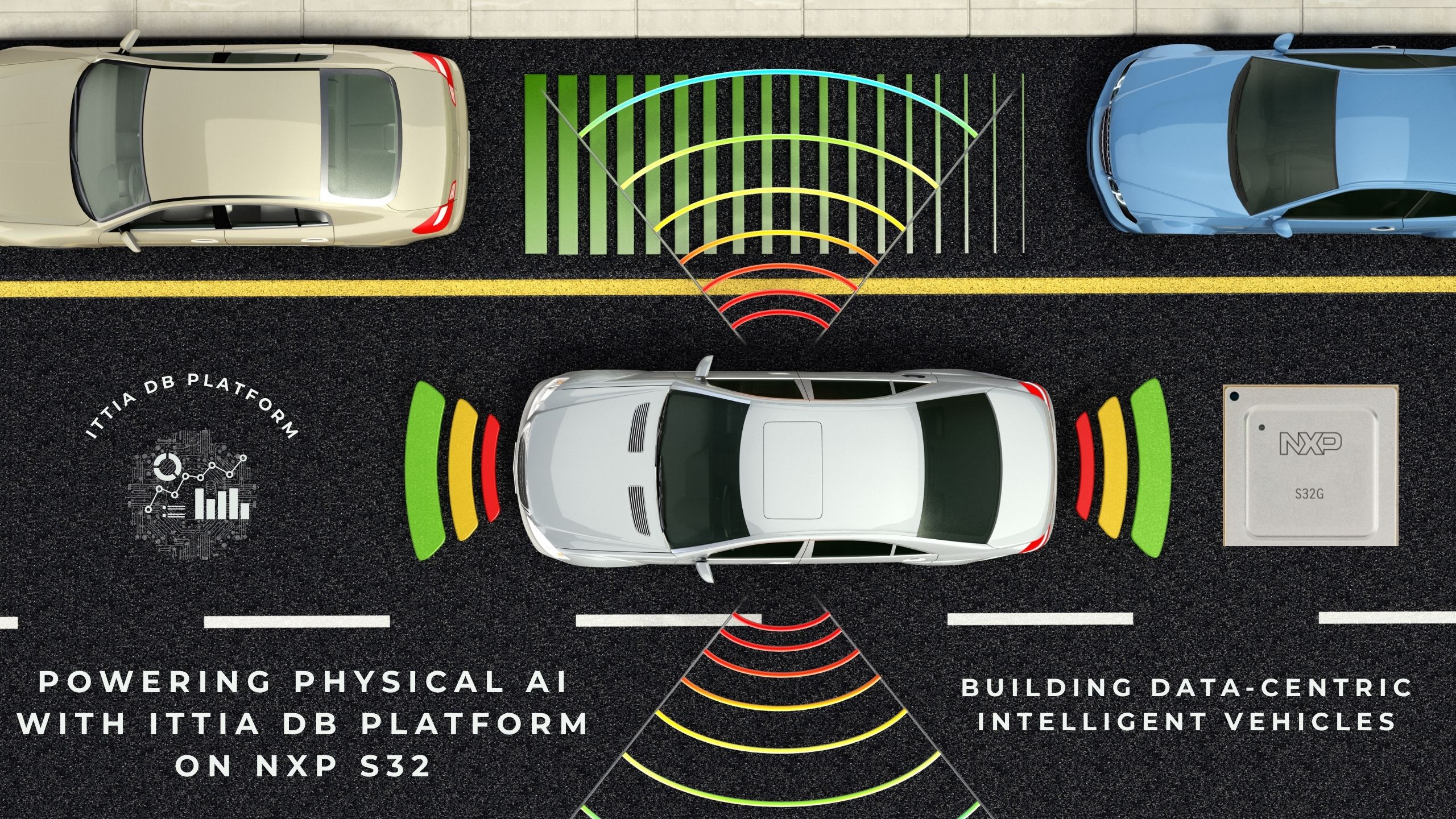
Powering Physical AI with ITTIA DB Platform on NXP S32
Building Data-Centric Intelligent Vehicles
The automotive industry is moving toward vehicles that continuously sense, understand, learn from, and react to the physical world. This transition is creating a new generation of software-defined vehicles in which artificial intelligence is no longer limited to centralized cloud systems. AI is moving directly into the vehicle. NXP S32 processors provide the computing foundation for many of these architectures. But compute alone does not create Physical AI.
A vehicle also needs a disciplined way to capture, organize, process, correlate, and preserve the enormous amount of data generated by its physical systems. This is where the ITTIA DB Platform becomes an important part of the architecture.
Physical AI Inside the Vehicle
A modern vehicle continuously generates data from CAN and other automotive networks, battery systems, electric motors, power electronics, temperature and vibration sensors, wheel and motion sensors, radar and perception systems, vehicle dynamics, body and zone controllers, diagnostics, gateways, and software-defined vehicle services.
Physical AI transforms this continuous stream of real-world information into intelligent decisions, helping identify abnormal vehicle behavior, predict component failures, estimate battery health, detect degradation, recognize unusual sensor patterns, support intelligent energy management, monitor motors and actuators, and improve overall vehicle observability.
However, AI cannot operate effectively on raw or disconnected data alone; it requires a reliable data foundation that can capture, organize, process, correlate, and preserve the information needed to provide context for intelligent decision-making.
The Data Layer Between Sensors and AI
A typical Physical AI pipeline in the vehicle can be represented as Vehicle Sensors and Networks to Data Management to Data Processing to AI Inference to Decision and then Vehicle Action. The ITTIA DB Platform provides the data-management and processing foundation within this pipeline, helping vehicle software organize, preserve, and prepare data close to where it is generated. Rather than forcing AI models to depend on unstructured buffers, isolated files, or disconnected sensor streams, ITTIA enables structured data to be maintained directly on the embedded processor with the context required for intelligent analysis. This becomes increasingly important as automotive architectures move toward distributed intelligence, where multiple processors, controllers, and AI functions must work together using consistent, reliable, and contextualized data.
Cortex-M and Cortex-A Working Together
NXP S32 architectures may involve both highly constrained real-time processors and more capable application-class processors. These processors perform different responsibilities. A Cortex-M-class controller may collect sensor information, execute deterministic control tasks, and run localized AI inference. A Cortex-A-class processor may perform larger-scale analytics, vehicle coordination, visualization, gateway functions, and more computationally demanding AI operations.
ITTIA DB Platform can provide a common data-management approach across these different computing environments. The result is a data-centric architecture in which information can move from low-level physical sensing to higher-level vehicle intelligence without losing structure or context.
Preparing Automotive Data for AI
Automotive data is rarely ready for AI immediately after it is captured. Raw CAN and sensor information often requires filtering, downsampling, normalization, rolling-window analysis, lag and delta calculations, statistical processing, RMS and variance analysis, FFT-based processing, time alignment, event correlation, and feature extraction before it can be effectively consumed by an AI model.
ITTIA technology can perform these data-processing and feature-engineering operations close to the source, allowing embedded automotive systems to transform continuous vehicle data into structured, AI-ready information. The resulting architecture becomes CAN / Sensor Data to ITTIA DB to Data Cleaning to Feature Engineering to AI Model to Inference to Vehicle Decision, creating a direct data pipeline from physical vehicle behavior to intelligent, actionable decisions.
Integration with AI Inference Engines
AI inference engines provide the model execution layer. For example, an NXP automotive platform may use an AI runtime such as eIQ Auto or another optimized inference engine. ITTIA does not replace the inference engine. Instead, ITTIA strengthens the data pipeline surrounding it. ITTIA manages the information entering the model and can preserve the results coming out of the model. This creates an important distinction: The inference engine executes intelligence. ITTIA DB manages the evidence behind that intelligence.
Predictive Maintenance and Vehicle Health
Predictive maintenance is a strong example of Physical AI in automotive systems. Consider an electric traction motor, where the vehicle may continuously monitor vibration, temperature, electrical current, RPM, torque, operating load, and historical operating conditions.
The ITTIA DB Platform can preserve these measurements, maintain their historical context, and generate meaningful features that can be evaluated by an AI model to identify abnormal patterns, detect developing faults, and anticipate maintenance needs.
The resulting inference can then be stored together with the underlying sensor data and engineered features, creating a traceable history of what the AI observed, how operating conditions changed, and what led to each conclusion. Over time, this transforms predictive maintenance from a single AI prediction into an observable, data-driven process that connects vehicle behavior, historical context, AI inference, and maintenance decisions.
Battery Intelligence
Battery systems are another strong application for Physical AI because battery condition and health cannot be accurately understood from a single measurement. AI models may need historical context involving voltage, current, temperature, charge and discharge cycles, operating conditions, cell imbalance, and degradation behavior to identify meaningful patterns over time.
The ITTIA DB Platform provides a structured way to preserve this history and make it available for AI-driven analysis, supporting State of Charge (SoC), State of Health (SoH), anomaly detection, degradation monitoring, and predictive analysis. By combining current measurements with historical behavior, embedded automotive systems can make more informed decisions about battery performance, efficiency, safety, and maintenance.
AI Observability in the Software-Defined Vehicle
As vehicles become increasingly software-defined, understanding AI behavior becomes just as important as running the model. A useful architecture can maintain:
Sensor → Measurement → Feature → Inference → Decision → Action
ITTIA DB can preserve this chain of information. ITTIA Analitica can then expose the information through dashboards and visualization, helping engineers understand what the AI observed, what features were generated, what conclusions were reached, and what action followed. This helps move automotive AI away from an opaque black box toward an observable system.
Data Remains Valuable After Inference
In many AI systems, valuable data is discarded once inference is complete, but in automotive applications that information can remain highly useful throughout the vehicle lifecycle. Historical AI data can support engineering analysis, vehicle diagnostics, performance optimization, anomaly investigation, validation, fleet analytics, model improvement, and overall system observability.
The ITTIA DB Platform enables the vehicle to retain the sensor context, processed data, features, inference results, and related operational information that matter most, creating a persistent record that engineers and intelligent systems can use to better understand vehicle behavior, investigate events, and continuously improve performance.
Physical AI and Software-Defined Vehicles
Physical AI represents a natural evolution of the software-defined vehicle, transforming the vehicle into a distributed intelligent computing platform. Sensors provide awareness of the physical environment, processors provide the computational capability, and AI provides inference and intelligence, but it is the data infrastructure that connects all three.
This is the role of the ITTIA DB Platform. NXP S32 processors provide powerful automotive compute, AI engines provide inference capability, and ITTIA DB Platform provides the structured data, historical context, processing, and observability needed to make Physical AI part of a complete vehicle architecture.
As AI moves deeper into the vehicle, data management becomes increasingly fundamental to automotive intelligence. The future vehicle will not simply run AI; it will need to understand, preserve, process, and explain the data behind AI-driven decisions. That is the foundation of data-centric Physical AI.
Conclusion
The ITTIA DB Platform helps NXP S32 developers build a stronger foundation for Physical AI by bringing structured data management, real-time data processing, historical context, feature engineering, AI enablement, inference traceability, and observability directly into the embedded automotive architecture.
On NXP S32G, this enables developers to transform CAN and sensor data into AI-ready information, support intelligent decision-making, preserve the evidence behind AI inference, and create more observable, data-centric software-defined vehicle systems. Developers interested in exploring these capabilities are invited to speak with ITTIA experts or request access to ITTIA demonstrations for data management, data processing, and AI enablement on S32G. Visit www.ittia.com to learn more, schedule a technical discussion, or request demonstration and evaluation access.
