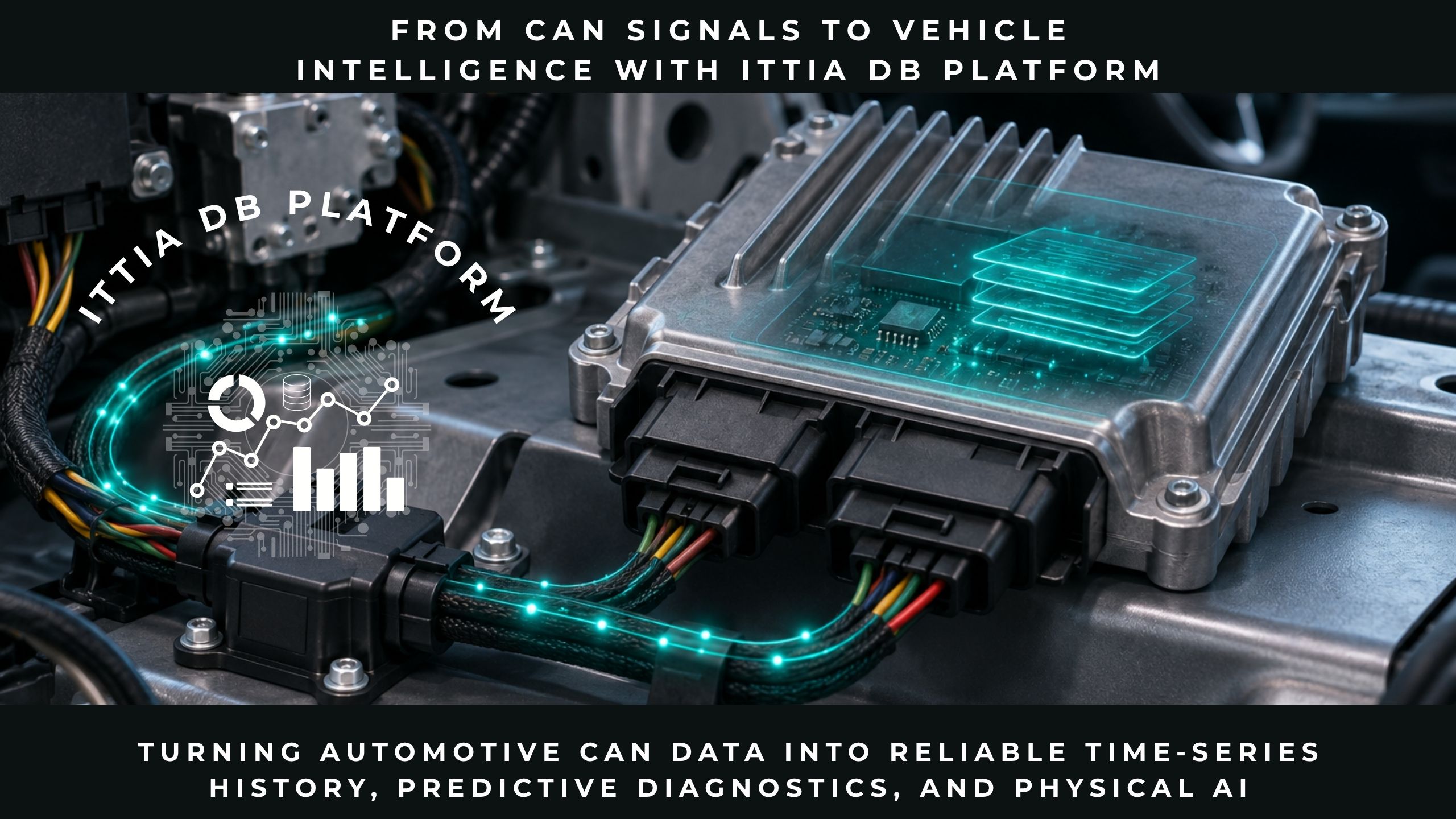
From CAN Signals to Vehicle Intelligence with ITTIA DB Platform
Turning Automotive CAN Data into Reliable Time-Series History,
Predictive Diagnostics, and Physical AI
Modern Software-Defined Vehicles (SDVs) continuously exchange information through CAN, CAN FD, and automotive Ethernet networks. Electronic control units (ECUs) transmit measurements such as motor speed, battery voltage, electrical current, temperature, and diagnostic events. However, CAN enables communication between vehicle systems; it does not provide persistent historical data management.
Once a CAN message is processed, its information may be lost unless the application explicitly records it. For intelligent diagnostics, predictive maintenance, and Physical AI, automotive developers need more than individual measurements. They need structured time-series history, reliable persistence, real-time analytics, and traceability. ITTIA DB Platform transforms transient CAN signals into persistent, actionable vehicle intelligence.
ITTIA DB Lite for Real-Time CAN Data Management
ITTIA DB Lite provides embedded time-series and transactional data management for resource-constrained microcontrollers, including supported NXP S32 Cortex-M configurations. It enables automotive developers to:
- Capture and preserve CAN measurements with timestamps, ECU identities, and operating conditions.
- Process time-series data using rolling averages, RMS, variance, and historical comparisons.
- Maintain transactional integrity and recover committed records following unexpected interruptions.
- Manage flash efficiently through selective recording and historical retention.
- Support anomaly detection using historical measurements and calculated features.
- Preserve diagnostic events for maintenance and engineering investigations.
ITTIA DB Lite AI extends these capabilities with AI-ready feature engineering and inference traceability. Together, they provide a structured data foundation for intelligent automotive applications.
Practical Example: CAN-Based Motor Health Monitoring on Cortex-M
Consider an NXP S32 Cortex-M application receiving motor RPM, current, and temperature measurements through CAN. The application collects measurements, calculates historical averages, and detects abnormal temperature conditions. The following simple C example illustrates this process.
#include <stdint.h>
#include <stdbool.h>

#define MOTOR_TEMP_LIMIT 85.0f
#define SAMPLE_WINDOW 100

typedef struct {
    uint64_t timestamp;
    float rpm;
    float current;
    float temperature;
} MotorData;

/* Application adapter for ITTIA DB Lite SDK */
extern bool ittia_store_motor_data(
    float avg_rpm,
    float avg_current,
    float avg_temperature,
    bool anomaly
);

static float rpm_sum = 0;
static float current_sum = 0;
static float temp_sum = 0;
static int count = 0;

bool process_can_data(const MotorData *data)
{
    if (!data)
        return false;

    rpm_sum += data->rpm;
    current_sum += data->current;
    temp_sum += data->temperature;

    count++;

    if (count < SAMPLE_WINDOW)
        return true;

    float avg_rpm = rpm_sum / count;
    float avg_current = current_sum / count;
    float avg_temp = temp_sum / count;

    bool anomaly = avg_temp > MOTOR_TEMP_LIMIT;

    /* Persist time-series features using ITTIA DB Lite */
    if (!ittia_store_motor_data(
        avg_rpm,
        avg_current,
        avg_temp,
        anomaly))
        return false;

    rpm_sum = 0;
    current_sum = 0;
    temp_sum = 0;
    count = 0;

    return true;
}
Note: ittia_store_motor_data() is an illustrative integration interface, not an official ITTIA SDK function. The example assumes CAN messages have already been decoded into engineering values. A production implementation must also define buffering and retry behavior when persistence fails.
What Does This Example Demonstrate?
The application processes 100 CAN-derived motor measurements and calculates average RPM, current, and temperature. When average temperature exceeds an illustrative threshold, it identifies an abnormal condition. ITTIA DB Lite provides the database foundation for recording calculated features and diagnostic information.
This enables engineers to investigate historical motor behavior rather than relying exclusively on current measurements.
The example uses basic threshold detection. More advanced predictive-maintenance applications can use ITTIA DB Lite AI to calculate historical features and supply them to compatible AI inference engines.
Connecting Cortex-M and Cortex-A with ITTIA DB Platform
On heterogeneous platforms such as NXP S32G, ITTIA DB Platform can connect real-time processing with vehicle-level analytics.
Technology | Automotive responsibility |
ITTIA DB Lite — Cortex-M7 | CAN data history, time-series processing, transactional recording |
ITTIA DB Lite AI — Cortex-M7 | Feature engineering, anomaly detection workflows, AI-ready data |
ITTIA DB — Cortex-A53/Linux | SQL analytics, historical queries, cross-ECU correlation |
ITTIA Data Connect | Selective synchronization between controllers and gateways |
ITTIA Analitica | Vehicle diagnostics, dashboards, historical visualization |
For example, an ECU can calculate motor-health indicators locally while an S32G gateway correlates them with battery and cooling-system information. This reduces unnecessary data movement while maintaining information needed for advanced diagnostics.
From CAN Data to Physical AI
Physical AI applications require reliable historical information to recognize abnormal behavior and support intelligent decisions. ITTIA DB Platform establishes a data-centric workflow that transforms CAN measurements into structured time-series history, prepares features for AI inference, supports diagnostic decisions, and records the resulting outcomes.
ITTIA DB Platform transforms CAN measurements into structured time-series history, enables feature engineering and AI inference for intelligent vehicle health assessment, and reliably records the resulting insights and outcomes for diagnostics, traceability, and continuous improvement. This approach supports:
- Predictive maintenance and motor-health monitoring.
- Battery SoC and SoH analysis.
- Vehicle fault diagnostics.
- Cross-ECU event correlation.
- AI inference history and traceability.
Conclusion: CAN Connects Vehicles. ITTIA DB Platform Connects Their Intelligence.
CAN and CAN FD provide essential communication between automotive controllers, but intelligent Software-Defined Vehicles require reliable historical information beyond individual messages.
ITTIA DB Platform bridges this gap by providing deterministic embedded data management, transactional persistence, time-series analytics, and AI-ready data processing across Cortex-M and Cortex-A environments.
By combining ITTIA DB Lite, ITTIA DB Lite AI, ITTIA DB, ITTIA Data Connect, and ITTIA Analitica, automotive developers can transform real-time CAN measurements into actionable intelligence for diagnostics, predictive maintenance, and Physical AI.
Explore ITTIA DB Platform for Automotive Applications
Developing an application on NXP S32K, S32G, S32N, or another embedded automotive platform? Contact ITTIA to discuss your CAN data-management requirements and explore how ITTIA DB Platform can accelerate your development.
