Beyond the IDE: Powering Edge AI with ITTIA DB Lite
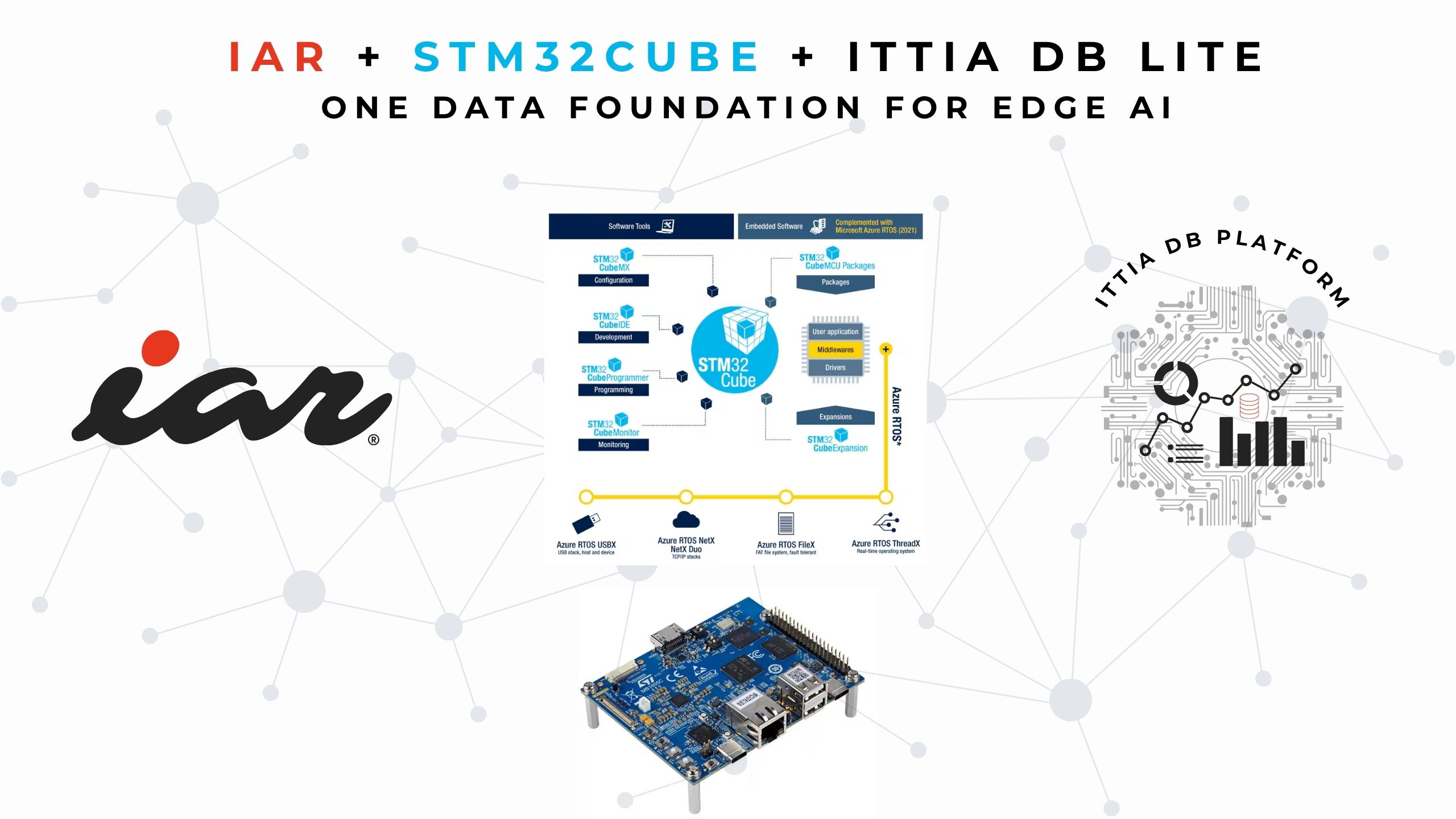
IAR + STM32Cube + ITTIA DB Lite: One Data Foundation for Edge AI
The competition between embedded development environments is evolving. Historically, developers evaluated toolchains primarily around compiler performance, debugging, code size, device support, configuration tools, development productivity, and production reliability. Those factors remain important. But Edge AI introduces an entirely different requirement: Data must become a first-class part of the embedded software architecture.
An AI model deployed on a microcontroller cannot create meaningful intelligence without reliable operational data, historical context, and a predictable method for transforming raw measurements into model-ready features. This is where the ITTIA DB Lite product family can create significant value for developers using either IAR Embedded Workbench or STM32Cube.
IAR and STM32Cube Solve Different Parts of the Development Problem
IAR Embedded Workbench provides an integrated commercial embedded toolchain with compiler, linker, debugger, and analysis capabilities, and IAR supports STM32 alongside numerous other processor architectures.
STM32Cube provides a highly STM32-centric development workflow. STM32CubeMX supports peripheral and middleware configuration and project generation, while STM32CubeIDE provides STM32-focused development and debugging.
For AI development, ST has also expanded its tooling with STM32Cube AI Studio, which evaluates, optimizes, validates, and compiles neural-network models for deployment on STM32 microcontrollers.
These tools help engineers create and deploy embedded software and AI models.
ITTIA addresses another challenge: What happens to the device data before, during, and after AI inference?
Edge AI Starts Before the Model
Consider a motor-health application. An STM32 MCU may receive vibration, current, temperature, speed, and load information. The AI model cannot necessarily make an effective motor-health decision using one instantaneous vibration reading.
The application may need historical windows containing hundreds or thousands of measurements. It may calculate RMS values, variance, peaks, changes between windows, frequency characteristics, or relationships between current, load, and vibration.
ITTIA DB Lite organizes and retains that operational history. ITTIA DB Lite AI helps transform that history into AI-ready features. The complete architecture becomes:
Sensor → Data Ingestion → Historical Window → Feature Engineering → AI Model → Inference → Device Action
This architecture is valuable whether the firmware is being built with IAR Embedded Workbench or STM32Cube.
The Database Becomes Part of the AI Pipeline
Traditional embedded applications frequently treat storage as something separate from processing. Edge AI changes this relationship. Historical information is often part of the algorithm itself.
For example, anomaly detection may depend on how today's vibration compares with the previous ten seconds. Battery intelligence may depend on changes in cell behavior over multiple cycles. Predictive maintenance may depend on gradual changes that occurred over days or weeks. A persistent embedded database can therefore become an active component of the AI processing architecture.
With ITTIA DB Lite and ITTIA DB Lite AI: Data management becomes AI infrastructure. The system can preserve not only the final inference but also the context that produced it.
That may include the original measurements, historical window, calculated features, model identity, confidence value, inference result, and device action. The result is a much more explainable Edge AI architecture.
Motor Health: The Same Data Architecture in Either IDE
Imagine two development teams building the same motor-health application. One uses IAR Embedded Workbench. The other uses STM32Cube. Both acquire vibration and motor current from the same type of STM32 MCU. Both need the same fundamental data workflow.
ITTIA DB Lite continuously ingests and organizes the motor data. Historical windows retain previous operating behavior. ITTIA DB Lite AI calculates model features. The AI model determines whether the motor is operating normally or beginning to show abnormal behavior. The processing architecture remains:
Vibration + Current + Temperature → ITTIA DB Lite → Historical Context → ITTIA DB Lite AI → AI Model → Motor Health
The toolchain choice changes how developers build, optimize, integrate, and debug the software. The ITTIA data architecture remains consistent. That consistency can become particularly important to organizations maintaining multiple products or supporting different MCU platforms.
Battery Management: Data Before AI
The same pattern applies to battery-management systems. A battery controller continuously observes cell voltage, current, temperature, State-of-Charge, balancing activity, and charging behavior. An AI model may need to identify changes in voltage consistency, thermal gradients, charge behavior, or differences between operating cycles. The database preserves the history. ITTIA DB Lite AI transforms that history into model-ready information. The pipeline becomes:
Battery Measurements → ITTIA DB Lite → Historical Behavior → Features → AI Inference → Battery Health
Again, whether the application is compiled in IAR or developed within STM32Cube does not change the underlying need for data.
STM32 AI + ITTIA DB Lite AI
ST's Edge AI tools focus strongly on bringing optimized trained models onto STM32 devices. STM32Cube AI Studio is currently positioned by ST as the new stand-alone environment for model evaluation, optimization, validation, and deployment on STM32 MCUs.
This creates a natural architectural relationship with ITTIA DB Lite AI. STM32 AI tooling answers: How do I deploy and optimize my AI model?
ITTIA DB Lite AI answers: How do I continuously prepare, organize, contextualize, and preserve the operational data around that model? Together, these technologies can create a more complete Edge AI workflow.
IAR + ITTIA DB Lite: Portability and Production Development
The value proposition for IAR is somewhat different. Because IAR supports development across a broad range of MCU and processor architectures, engineering organizations may use IAR as a standardized toolchain across products from multiple semiconductor vendors.
ITTIA DB Lite can complement this approach with a reusable application-level data architecture.
A company building an industrial controller on STM32 today and another MCU-based system tomorrow may still need historical data management, event storage, Edge AI feature preparation, and device-level analytics. The silicon may change. The development environment may remain IAR. And the data-management architecture can remain ITTIA. That creates the possibility of greater software reuse at the application-data level.
STM32Cube + ITTIA DB Lite: Deep STM32 Integration
For teams committed primarily to STM32, the combination has a different advantage. STM32Cube provides access to ST's device configuration, middleware, software ecosystem, and increasingly integrated Edge AI development capabilities. STM32CubeMX can generate initialization code for STM32 peripherals and middleware, while STM32Cube AI Studio supports model deployment and optimization. ITTIA DB Lite adds structured embedded data management directly into that workflow. Developers can move from:
Peripheral Configuration → Sensor Acquisition → Database → Feature Engineering → AI → Application
Rather than:
Peripheral Configuration → Sensor Acquisition → Custom Buffers → Custom Files → Custom History Logic → Custom Feature Pipeline → AI
That distinction can become significant as embedded applications grow more complex. Competition Creates Choice. Data Architecture Creates Continuity.
IAR Embedded Workbench and STM32Cube will continue to offer developers different strengths and development philosophies. Teams may choose IAR because of compiler technology, debugging, analysis, organizational tool standardization, or multi-vendor development. Other teams may choose STM32Cube because of its close relationship to STM32 hardware, peripheral configuration, ST middleware, and STM32 AI ecosystem.
Some organizations may use elements of both. STM32CubeMX officially supports project generation for IAR Embedded Workbench as well as STM32CubeIDE. The important point is that ITTIA DB Lite does not need to compete with either environment. It strengthens both.
A Common Data Foundation for Intelligent Embedded Systems
The ITTIA DB Lite product family introduces another layer into the embedded development stack:
Development Toolchain → Device Software → Data Infrastructure → Edge AI → Intelligent Application
ITTIA DB Lite provides persistent, structured embedded data management. ITTIA DB Lite AI connects historical data with feature engineering and AI inference. For an IAR developer, this adds a reusable data layer to a high-performance embedded development workflow. For an STM32Cube developer, it adds persistent operational data and AI context around STM32's hardware and AI ecosystem. The result is not simply a better way to store data. It is a stronger architecture for building intelligent devices. IAR or STM32Cube may determine how the application is developed. ITTIA DB Lite helps determine how the application understands its data. And for Edge AI, that data can be as important as the model itself.
