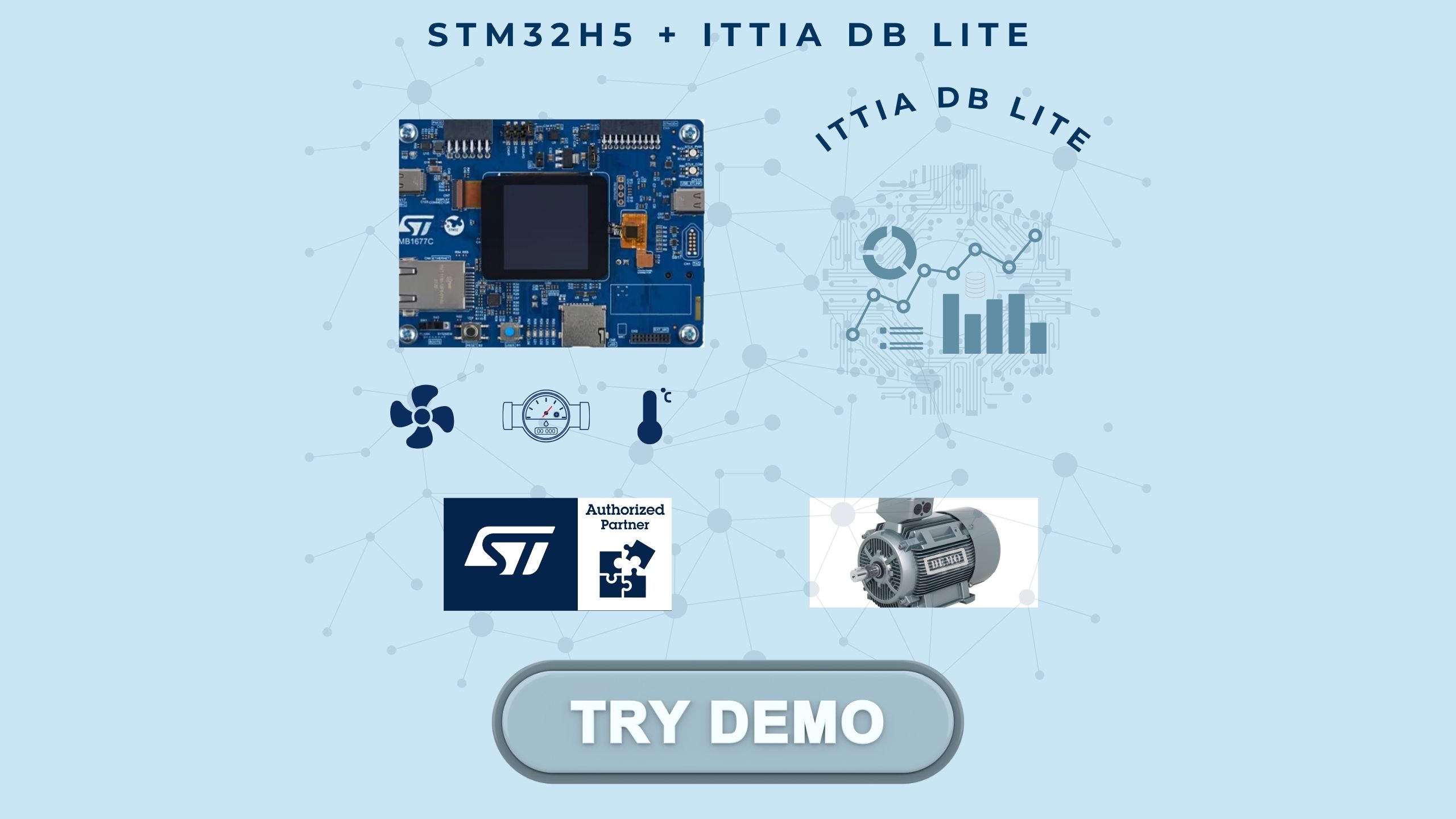
Building Intelligent Motor Health Monitoring at the Edge
STM32H5 + ITTIA DB Lite
Modern motor-health systems need more than sensor acquisition and threshold-based alarms. Motors continuously generate valuable operational data through vibration, current, temperature, speed, load, and other signals. The challenge is turning those continuous measurements into meaningful information that can identify developing problems before they become failures.
The STM32H5, combined with the ITTIA DB Lite product family, provides a data-centric foundation for building intelligent motor-health applications directly at the edge. STM32H5 provides the MCU processing environment, while ITTIA DB Lite and ITTIA DB Lite AI enable local data management, historical analysis, feature engineering, and AI inference workflows without requiring continuous cloud connectivity.
Motor Health Is a Historical Data Problem
Traditional motor monitoring commonly depends on fixed thresholds. If vibration, temperature, or current exceeds a predefined limit, the application generates an alarm.
However, many mechanical and electrical problems develop gradually. Bearing wear, imbalance, misalignment, lubrication degradation, abnormal loading, and other conditions may initially appear as subtle changes across several measurements rather than as one obvious threshold violation.
A single vibration measurement provides only the current condition. A historical sequence can show whether vibration is increasing, becoming less stable, or changing under specific motor loads. This makes historical data particularly important for Edge AI.
ITTIA DB Lite as the Local Data Foundation
The ITTIA DB Lite product family is designed for resource-constrained microcontroller environments and can support MCUs from a variety of semiconductor vendors, provided the target device offers adequate memory, storage, and processing resources for the intended application.
This flexibility allows developers to apply the same embedded data-management and Edge AI architecture across multiple MCU platforms, including the broad STM32 family. For the purpose of this blog, however, we will focus specifically on STM32H5 as a representative platform for demonstrating how ITTIA DB Lite and ITTIA DB Lite AI can enable structured data management, historical processing, feature engineering, and intelligent Edge AI applications directly on the microcontroller.
An STM32H5-based system can continuously acquire vibration, temperature, motor current, rotational speed, and other measurements directly from sensors.
ITTIA DB Lite provides structured transactional and time-series data management for this information directly on the MCU.
Instead of treating measurements as temporary values that disappear after processing, the application can maintain useful historical windows and query them locally. The system can compare current operating behavior with previous seconds, minutes, operating cycles, or other relevant periods. The processing path begins with:
Motor Sensors → STM32H5 → ITTIA DB Lite → Historical Motor Data
This local history creates the foundation for deeper analysis.
Turning Historical Data into AI Features
Raw sensor measurements alone may not provide the most useful input for an AI model.
For example, vibration monitoring may require features such as RMS, variance, peaks, frequency characteristics, changes between windows, or other statistical indicators. Motor-current and temperature histories may provide additional context that helps distinguish normal load changes from developing mechanical problems.
ITTIA DB Lite AI extends the data-management foundation by using historical information to support feature engineering and AI-ready data preparation.
The processing pipeline moves continuously from sensor acquisition to intelligent motor-health decisions. ITTIA DB Lite captures and organizes incoming sensor data, while historical windows preserve the operating context needed for analysis. ITTIA DB Lite AI then transforms that historical data into meaningful features that can be provided to an AI model for anomaly detection, condition assessment, and motor-health decisions. This creates a direct connection between persistent device data and the complete Edge AI workflow.
Moving Beyond Threshold-Based Monitoring
Consider a motor operating normally for an extended period. Over time, vibration variance begins increasing slightly while temperature rises gradually during high-load operation. Motor current also begins showing a different pattern.
None of these measurements may independently exceed an alarm threshold. An AI model using historical features, however, may recognize that the combined behavior no longer matches the motor's normal operating pattern. The STM32H5 can detect this change locally and generate an anomaly or motor-health score before a conventional threshold alarm occurs.
The application can preserve the complete data path from the original sensor measurement through the historical window, feature engineering, AI model, inference result, and final motor-health decision. This provides more than anomaly detection—it preserves the context behind each AI result, helping engineers understand what data was used, how the model reached its conclusion, and why a particular motor-health condition was identified.
Local Edge AI Without Continuous Cloud Connectivity
The motor-health application can continue collecting data, maintaining history, engineering features, running inference, and taking action directly on STM32H5.
This allows the system to operate even when a cloud connection is unavailable or undesirable. Rather than continuously transmitting large volumes of raw vibration data, the device can retain detailed information locally and communicate only information with higher operational value, such as an anomaly, health score, diagnostic summary, or selected data window surrounding an important event. This architecture can reduce bandwidth requirements while providing faster local response.
A Practical STM32H5 Motor Health Demonstration
A practical demonstration can show the complete journey from motor signals to intelligent decisions. An STM32H5-based system continuously captures vibration, current, temperature, and speed information. ITTIA DB Lite ingests and organizes these measurements into historical time-series data. ITTIA DB Lite AI then uses the historical data to calculate features required by an anomaly-detection model.
During normal motor operation, the AI establishes or recognizes the expected operating pattern. A change in vibration, load, temperature, or other behavior can then be introduced to demonstrate how the system detects a deviation.
Participants can observe the complete transformation from live motor data to historical context, feature generation, AI inference, anomaly detection, and final motor-health insight. The demonstration shows that the database is not simply a storage component; it becomes an active part of the Edge AI processing architecture by organizing device data, preserving history, supporting feature engineering, and providing the context required for meaningful and explainable AI decisions.
From Motor Data to Motor Intelligence
The value of the ITTIA DB Lite product family is the ability to turn continuous MCU data into structured historical context that can be used for intelligent processing. ITTIA DB Lite manages the data. ITTIA DB Lite AI transforms that history into AI-ready information. STM32H5 provides the MCU processing platform where the entire workflow can operate close to the motor. Together, they enable an architecture in which the device can continuously collect, remember, analyze, and act.
STM32H5 + ITTIA DB Lite transform motor signals into data-driven Edge AI intelligence.
