The Data-Defined Vehicle: The Future Just Arrived
Building Production-Ready SDV Intelligence on NXP S32 with ITTIA DB Platform
The Software-Defined Vehicle is changing the automotive industry from a hardware-centric model into a continuously evolving software and data platform. NXP S32 processors provide a powerful foundation for this transformation, spanning vehicle gateways, zonal controllers, domain control, and real-time embedded functions.
But a successful SDV requires much more than software updates and powerful processors. It requires a complete architecture built around system design, data management, AI integration, security, real-time performance, validation, and a deep understanding of the entire vehicle application.
This is where the ITTIA DB Platform and ITTIA experts can add significant value to NXP S32-based development.
SDV Starts with Architecture
Modern vehicles contain dozens of intelligent functions distributed across MCUs, MPUs, ECUs, gateways, and vehicle networks. These systems must work together while continuously collecting data from CAN, sensors, actuators, batteries, motors, power electronics, cameras, and other subsystems. The first challenge is architectural.
Developers must decide which data remains inside an ECU, which data should be shared across the vehicle, what information should be retained historically, what processing belongs on Cortex-M-class controllers, what belongs on higher-performance Cortex-A environments, and what eventually moves to the cloud.
ITTIA experts can help development teams design this complete data architecture around NXP S32 platforms rather than treating each ECU as an isolated system.
A modern SDV data path can look like:
Vehicle Sensors and CAN, ITTIA DB Lite, Local Processing, Feature Engineering, AI Inference, Vehicle Decision, ITTIA Data Connect, ITTIA DB, and ITTIA Analitica.
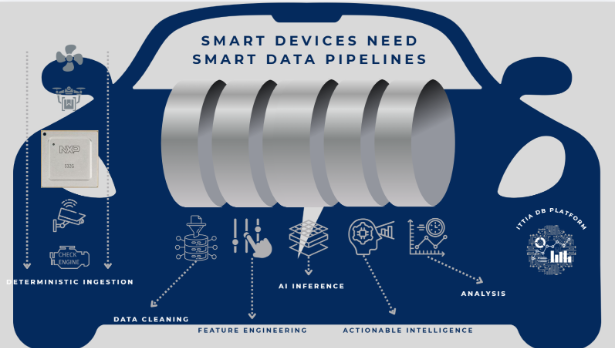
This creates a consistent data foundation from the constrained ECU to vehicle-level intelligence.
Data Management Is Becoming Central to SDV
Software-defined vehicles generate enormous amounts of operational data, but collecting data alone does not create intelligence.
Vehicle applications need to organize, retain, correlate, process, and selectively distribute the information that matters. A battery-management ECU may need historical cell voltage, current, temperature, charge cycles, and previous state-of-health calculations. A traction motor application may require vibration, current, speed, temperature, and previous anomaly information. A zonal controller may need to correlate data across multiple devices and networks.
This is where ITTIA DB Lite can provide a structured data-management foundation for NXP S32 microcontroller environments. Instead of relying on application-specific files, buffers, and custom persistence logic, developers can build around an organized and reusable data architecture designed for constrained embedded systems.
AI Integration: Moving Beyond Simple Inference
AI is becoming an important part of the Software-Defined Vehicle, but inference alone is not enough. AI needs historical context, clean data, synchronized signals, meaningful features, and reliable access to information at the right moment.
ITTIA DB Lite AI can provide the data infrastructure surrounding AI inference on NXP S32 platforms. It can support historical data management, preprocessing, feature engineering, and traceability while complementing technologies such as NXP eIQ and eIQ Auto.
The architecture becomes:
CAN / Sensor Data → Historical Context → Data Processing → Feature Engineering → eIQ AI Model → Inference → Decision → Trace
This allows the AI engine to focus on inference while ITTIA manages the information that makes inference useful in a real vehicle.
Cortex-M and Cortex-A Must Work Together
One of the defining characteristics of modern SDV architectures is the combination of constrained real-time controllers and more capable application processors. NXP S32 platforms can span these environments.
Cortex-M-class devices may handle local control, sensor acquisition, body functions, battery management, or zonal intelligence, while Cortex-A-class processors can perform richer analytics, gateway functions, connectivity, and vehicle-level processing. The challenge is making these systems work together.
ITTIA DB Lite can manage data close to the real-time function. ITTIA Data Connect can move selected information between embedded systems. ITTIA DB can provide richer relational and time-series management on higher-level processors. ITTIA Analitica can give engineers visibility into vehicle behavior, AI results, trends, and anomalies.
This creates a scalable architecture rather than a collection of disconnected software components.
Security Must Protect the Data, Not Only the Software
SDVs are increasingly connected, updateable, and data-driven. That creates new security requirements. Secure boot, firmware protection, OTA updates, and network security are essential, but vehicle data itself must also be protected. Operational history, AI results, configuration changes, diagnostics, and safety-related events may require confidentiality, integrity, controlled access, and auditability.
ITTIA can help developers build a secure data layer that works alongside the hardware security capabilities of NXP S32 platforms. Security should therefore extend across the complete chain: Sensor, ECU Data, AI Processing, Vehicle Decision, Data Distribution and Analysis. Protecting that chain is critical for building trustworthy SDV systems.
Real-Time Performance Is Non-Negotiable
Automotive systems are different from cloud applications because timing failures can become system failures. A vehicle ECU cannot pause because a storage operation takes too long. A battery-management controller cannot miss critical sensor data because background processing consumed resources. An AI result is only useful if it arrives within the application's required time window. That is why data management on NXP S32 must be designed with real-time performance in mind.
ITTIA focuses on embedded data architectures that can help developers evaluate ingestion latency, storage behavior, query performance, feature-generation timing, AI handoff, recovery behavior, and resource utilization. For SDV developers, the important question is not simply: How fast is the system? It is: Can the system deliver predictable performance under real vehicle workloads?
Validation: From Automotive Demo to Production Vehicle
A prototype can show that an AI model works or that an ECU can collect CAN data. Production validation is much more demanding.
An SDV platform must be tested under sustained data loads, communication interruptions, power cycling, memory pressure, flash activity, network congestion, sensor anomalies, and unexpected operating conditions. ITTIA experts can help development teams define meaningful validation plans around the complete data pipeline.
That can include testing: data ingestion, persistence, processing, feature generation, AI inference, decision, recovery, and traceability. This broader approach helps development teams move from a functional demonstration toward a production-ready automotive architecture.
Traceability Matters in Intelligent Vehicles
As AI begins influencing more vehicle decisions, developers need visibility into how those decisions were produced. A structured data foundation can preserve the path:
Vehicle Sensor → Raw Data → Processed Data → Feature → AI Inference → Decision → Vehicle Action
This trace can support debugging, validation, quality assurance, AI observability, and development processes associated with safety-critical automotive systems. It also gives engineering teams something extremely important: context. Rather than seeing only an anomaly score or classification, they can understand which data produced it and what happened afterward.
Understanding the Complete SDV Application
Perhaps the most important challenge in Software-Defined Vehicles is that no single component operates independently. Vehicle networks matter. ECU memory constraints matter. Real-time control matters. AI models matter. Cybersecurity matters. OTA strategy matters. Historical data matters. Gateway architecture matters. Cloud connectivity matters. A successful SDV platform must account for all of these elements together. This is where ITTIA experts can provide value beyond the software itself.
ITTIA can work with automotive engineering teams to understand the complete application, define data ownership and movement, determine how information should be processed at each computing level, integrate AI, establish traceability, validate performance, and create an architecture that can evolve with the vehicle.
ITTIA DB Platform + NXP S32: A Data Foundation for SDV
The ITTIA DB Platform can provide consistent data architecture across the vehicle:
ITTIA DB Lite for constrained NXP S32 MCU environments. ITTIA DB Lite AI for historical context, feature engineering, and Edge AI pipelines. ITTIA Data Connect for selective and secure distribution of information between ECUs, gateways, and higher-level systems. ITTIA DB for richer data management on application processors and vehicle compute platforms. ITTIA Analitica for visualization, observability, diagnostics, and analysis of vehicle and AI behavior.
Together with NXP S32 hardware and AI technologies, this can create a powerful foundation for the next generation of Software-Defined Vehicles.
From Software-Defined to Data-Defined
The Software-Defined Vehicle is ultimately becoming a data-defined vehicle. Software provides flexibility. AI provides intelligence. But data provides the context that allows the vehicle to understand its environment, its components, its history, and its own behavior.
The winning SDV architectures will not simply run more software or deploy more AI models. They will manage vehicle data intelligently across every computing layer. NXP S32 provides the computing foundation. ITTIA DB Platform provides the data foundation. Together, they can help transform vehicle data into reliable, secure, real-time intelligence.
