QNX Runs the Mission-Critical System. ITTIA Makes Its Data Intelligent.
Edge Data Infrastructure for RTOS Intelligence
In embedded systems, reliability is not optional. Automotive controllers, industrial machines, medical devices, robotics platforms, and other mission-critical systems must operate predictably, recover cleanly, protect critical information, and increasingly support AI-driven decisions at the edge.
QNX provides a strong real-time operating system foundation for these environments. But as embedded applications become more data-intensive and AI-enabled, the operating system is only one part of the complete architecture.
Developers also need a dependable way to manage operational and historical data, prepare that data for AI, distribute it across the system, observe what is happening, and validate that the complete application behaves as expected.
This is where the ITTIA DB Platform and ITTIA embedded systems expertise can complement QNX.
The Real Challenge Is the Complete Application
A modern embedded system is no longer simply an RTOS running a few deterministic tasks. It may continuously ingest sensor and network data, execute control logic, maintain historical records, perform local analytics, generate AI features, run inference, communicate with other processors, and provide observability for engineering and operations teams.
The complete flow can look like:
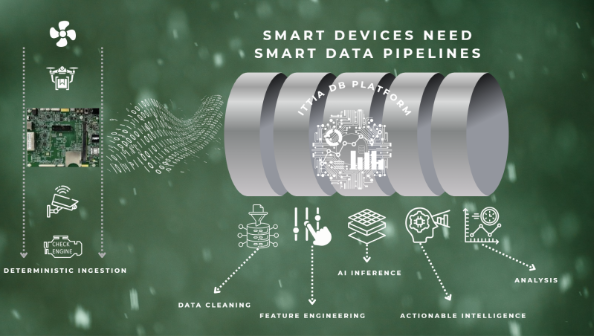
Sensors and Devices → QNX Applications → ITTIA DB → Data Processing → AI Integration → Decision → ITTIA Data Connect → ITTIA Analitica
Each stage introduces architectural decisions that affect performance, reliability, security, and maintainability. The real engineering challenge is making all of these components operate as one predictable system.
QNX Provides Real-Time Control. ITTIA Provides the Data Foundation.
QNX is built for embedded applications where isolation, availability, and real-time behavior are critical. ITTIA DB can add a structured data-management layer within that environment, helping applications organize, persist, query, and process operational information close to where it is generated.
This can be particularly valuable when developers otherwise must construct custom files, logging formats, indexing mechanisms, historical buffers, and recovery logic for each application. A structured data layer allows information to become part of architecture rather than an afterthought.
For example, an industrial control system may need to retain machine state, alarms, operating conditions, maintenance history, and AI results. An automotive gateway may need to organize vehicle events and selected ECU information. A medical system may need reliable records associated with device activity and system behavior.
ITTIA DB gives those applications a consistent data foundation while QNX continues to manage the real-time execution environment.
System Architecture Must Define Where Data Lives
One of the most important questions in an embedded system is not simply how much data is generated, but where that data should live and what should happen to it. Should the information remain local? Should it be summarized? Which data needs historical retention? What should move to another processor or cloud platform? Which applications require immediate access? Which records must survive power loss?
ITTIA experts can work with QNX development teams to answer these questions early in the architecture process. The goal is to define a clear data lifecycle: Capture, Persist, Process, Analyze, Distribute, and Observe. When that lifecycle is designed correctly, the system becomes easier to scale, validate, and maintain.
AI Integration Requires More Than an Inference Engine
AI is increasingly becoming part of embedded applications running on powerful processors and heterogeneous compute platforms. But inference is only one step. AI models often require historical context, correlated sensor information, data cleaning, normalization, windowing, and feature preparation. After inference, the system may also need to preserve the result, understand which data produced it, and determine what action followed. ITTIA DB Platform can help provide this surrounding data infrastructure. The architecture can become: Operational Data, Historical Context, Processing, Feature Engineering, AI Model, Inference, Decision, and Trace.
QNX can provide the predictable execution environment while ITTIA DB manages the data pipeline that makes AI useful in a real production system. This creates a cleaner separation between compute, operating-system services, and data intelligence.
Real-Time Performance Is About Predictability
Embedded systems are not measured only by average performance. A database operation that is usually fast but occasionally blocks a critical task can create problems in a real-time system. That is why the interaction between data management and QNX scheduling must be carefully understood.
Developers need visibility into data-ingestion latency, transaction behavior, read and write performance, storage activity, recovery behavior, and the effect of analytics or AI pipelines on higher-priority tasks.
ITTIA's embedded expertise can help teams design and validate data workloads in the context of the complete real-time system. The critical question is not simply: Is data access fast? It is: Can data access remain predictable while the rest of the application is operating under real workload conditions?
Security Must Extend to Operational Data
QNX-based systems are often deployed in environments where cybersecurity, access control, and system integrity are central requirements. But securing the operating system alone is not enough. Applications also need to protect the information they generate and retain.
Operational history, device states, diagnostic events, configuration information, AI outputs, and system logs may require controlled access, integrity protection, encryption, and auditability.
ITTIA DB can provide a structured foundation for protecting this information and integrating data security into the broader system architecture. The objective is end-to-end protection: Device Data, Application, Persistent Storage, AI Processing, Distribution and Analysis. Security becomes part of the data lifecycle, not simply a perimeter around the device.
ITTIA Data Connect: Connecting Intelligence Across Embedded Systems
Many QNX systems are part of a larger distributed architecture. A vehicle may contain multiple ECUs and gateways. An industrial system may include controllers, edge gateways, and supervisory systems. A medical device may need to exchange selected information with another embedded computer or management platform. ITTIA Data Connect can help move selected data between these environments without requiring every raw data point to leave the originating system.
This supports an important Edge AI principle: process as much as possible locally, then distribute only the information that has value. Instead of moving everything, the application can distribute selected events, aggregated information, AI results, or relevant historical windows. That can reduce bandwidth, improve responsiveness, and support more resilient architectures.
Analytica: Making Embedded Systems Observable
Real-time embedded systems often generate valuable information that is difficult to understand without appropriate visualization. ITTIA Analitica can provide visibility into operational data, trends, anomalies, AI results, system performance, and historical behavior.
This creates a bridge between the embedded system and the engineers or operators responsible for understanding it. Observability becomes particularly important when AI is involved. Developers need to know not only that an AI model generated a result, but what happened before and after that result.
A trace such as: Sensor, Raw Data, Processed Data, Feature, Inference, Decision, and Action can provide the context needed for debugging, validation, quality assurance, and AI observability.
Validation Must Test More Than the RTOS
A QNX application may meet its scheduling requirements and still encounter problems when storage, networking, AI, and data processing are added. That is why validation should address the complete application.
Testing should consider sustained data ingestion, storage pressure, power interruption, communication loss, unexpected sensor conditions, AI workload, resource contention, and recovery.
ITTIA experts can help development teams define validation criteria that cover the data layer as part of the real-time system.
This can include measurements around throughput, latency, memory use, storage behavior, recovery, AI handoff, and traceability. The result is a stronger path from prototype to production.
The Value of Understanding the Entire System
Perhaps the greatest advantage of combining ITTIA expertise with QNX is the ability to look beyond individual software components. A successful embedded system depends on the relationship between the processor, operating system, application threads, storage, networking, device data, AI, security, and system requirements.
Optimizing any one of these in isolation may not optimize the system. ITTIA works with development teams to understand the complete application and determine how data should be managed within that architecture.
This includes questions such as: How should the database interact with real-time tasks? Which data requires immediate persistence? How much historical context should remain local? What information should feed AI? What should be transmitted elsewhere? How should results be traced and validated?
These are architectural questions, and answering them early can significantly reduce development risk.
ITTIA DB Platform + QNX: From Real-Time Execution to Real-Time Intelligence
The combination of QNX and the ITTIA DB Platform can create a broader foundation for intelligent embedded systems. QNX provides the real-time operating environment. ITTIA DB provides structured operational and historical data management. ITTIA Data Connect connects selected information across distributed embedded systems. ITTIA Analitica provides visibility and observability into system and AI behavior.
Together, these technologies can support the full path:
Device → Real-Time Application → Data → AI → Decision → Distribution → Observability
That is an increasingly important architecture for automotive, industrial automation, medical systems, robotics, energy, and other mission-critical applications.
Real-Time Systems Are Becoming Data-Intelligent Systems
The next generation of embedded systems will require more than deterministic execution. They will need to understand their own data. They will need to preserve history, recognize patterns, support AI, protect critical information, explain decisions, and communicate intelligence across the system.
QNX provides the foundation for dependable real-time computing. The ITTIA DB Platform provides the data foundation that can help transform that computing environment into an intelligent, observable, and data-centric embedded system. QNX keeps the system running. ITTIA helps the system understand what its data means.
