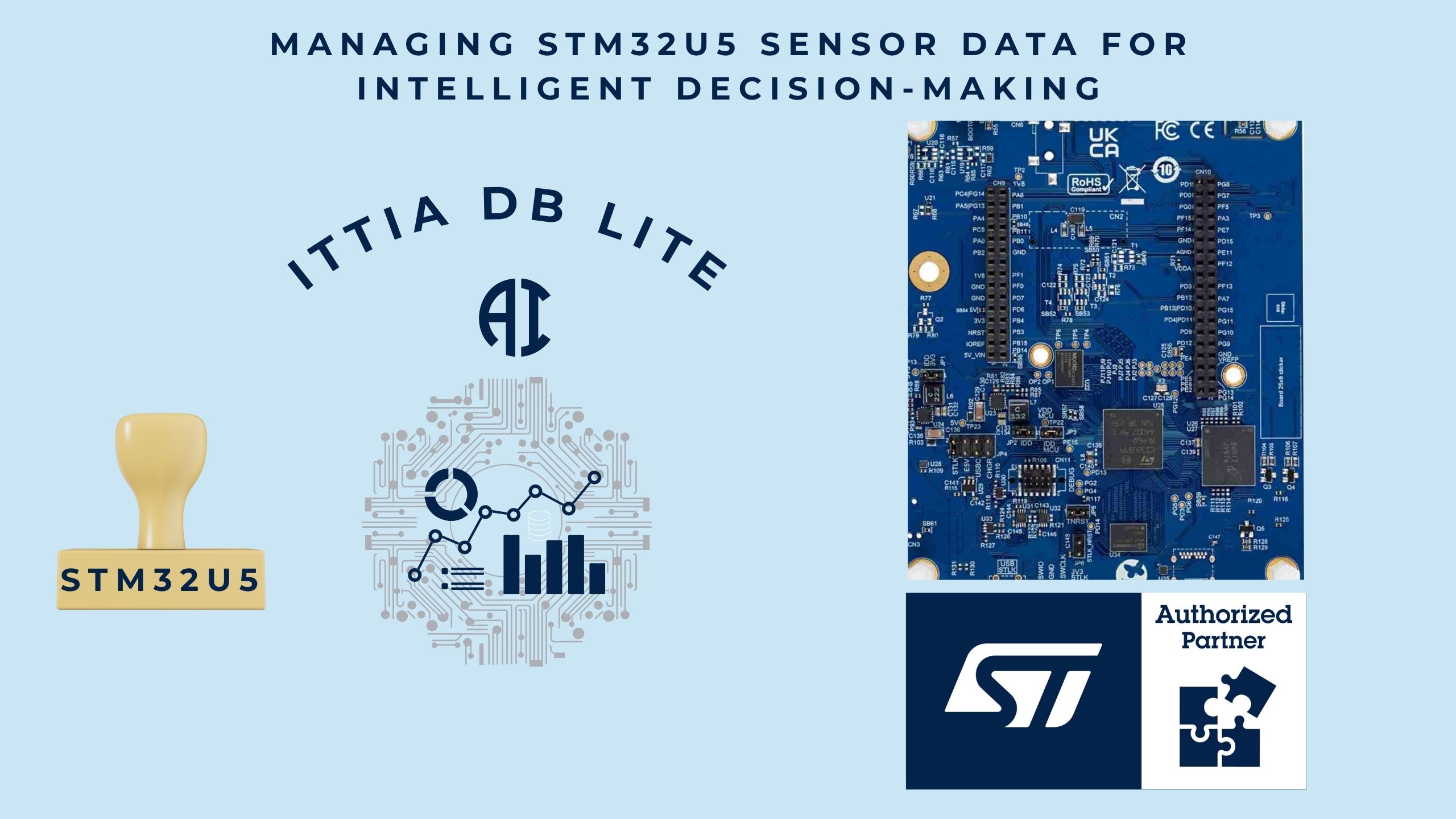
Managing STM32U5 Sensor Data for Intelligent Decision-Making
Anomaly Detection, Predictive Maintenance, and Safety-Ready Industrial Systems
Industrial automation is evolving rapidly. Manufacturing equipment, industrial motors, pumps, compressors, robotic systems, and intelligent sensors are becoming increasingly connected, autonomous, and data-driven.
Traditionally, microcontrollers have been responsible for reading sensors, executing control algorithms, and responding to predefined operating conditions. Today, industrial applications must do considerably more. They must continuously collect measurements, maintain reliable historical information, detect anomalies, predict equipment deterioration, and preserve operational records for diagnostics, maintenance, and safety investigations.
At the same time, these capabilities must operate within strict constraints involving real-time performance, memory consumption, power efficiency, flash endurance, cybersecurity, and functional safety.
This introduces an important engineering challenge: How can industrial equipment manufacturers transform continuous sensor measurements into actionable intelligence while maintaining the reliability, security, predictability, and traceability expected from industrial automation systems?
The combination of STMicroelectronics STM32U5 and the ITTIA DB Lite Product Family provides a foundation for addressing these requirements.
STM32U5 delivers energy-efficient Arm Cortex-M33 processing, integrated peripherals, and hardware-assisted security capabilities. ITTIA DB Lite provides deterministic time-series data management, transactional integrity, and historical storage, while ITTIA DB Lite AI extends this foundation into feature engineering, anomaly detection workflows, and AI inference traceability.
Together, these technologies enable industrial developers to move beyond conventional data logging toward intelligent, data-centric industrial monitoring.
STM32U5: A Foundation for Intelligent Industrial Monitoring
The STM32U5 microcontroller family combines ultra-low-power operation with processing and security capabilities suitable for industrial sensing, measurement, and monitoring applications.
Based on the Arm Cortex-M33 architecture, STM32U5 offers integrated memory, analog and digital interfaces, DMA capabilities, and security features including Arm TrustZone and hardware cryptographic acceleration on supported devices.
These characteristics make STM32U5 attractive for applications that must operate continuously while efficiently processing and protecting information.
Potential industrial applications include:
- Industrial motor and pump condition monitoring.
- Predictive maintenance sensors.
- Factory automation and equipment diagnostics.
- Industrial vibration and temperature monitoring.
- Smart instrumentation and measurement systems.
- Energy and power monitoring.
- Distributed industrial controllers.
- Intelligent industrial IoT devices.
However, acquiring measurements is only the beginning. Intelligent industrial applications must understand how operating conditions evolve, recognize abnormalities, and preserve information that can explain what happened before and after an event.
This is where embedded data management becomes essential. STM32U5 provides the processing platform. ITTIA DB Lite provides the data foundation that turns industrial measurements into structured history, useful intelligence, and actionable information.
The Missing Component in Traditional Industrial Monitoring: Historical Context
Consider an industrial electric motor operating continuously inside a manufacturing facility. A monitoring system collects vibration, current, temperature, and rotational-speed measurements. A conventional implementation may compare each measurement against a predefined threshold. If the temperature exceeds a configured limit, an alarm is generated.
However, equipment degradation often develops gradually. A bearing may begin deteriorating long before any individual sensor measurement exceeds its alarm threshold. Vibration RMS may increase over several days. Motor current may gradually rise under similar operating loads. Temperature may slowly drift away from its normal operating range. Without historical context, these developments may go unnoticed.
More sophisticated monitoring requires answers to questions such as:
- Is the current vibration level abnormal compared with previous operating conditions?
- Has motor current increased under similar mechanical loads?
- Is temperature rising gradually even though it remains below the alarm threshold?
- Are multiple measurements showing correlated changes?
- What were the operating conditions before an anomaly?
- Can the system recover the diagnostic history after an unexpected reset?
- Can engineers trust that recorded information has not been modified?
Answering these questions requires structured time-series history, statistical processing, reliable persistence, and traceability. The ITTIA DB Lite Product Family provides the data-management infrastructure needed to support these capabilities directly on STM32U5.
ITTIA DB Lite: Deterministic Time-Series Data Management
ITTIA DB Lite is designed for resource-constrained microcontrollers that require structured time-series processing, transactional consistency, and reliable historical data management.
Rather than requiring developers to implement custom file handling, data indexing, retention policies, and recovery mechanisms, ITTIA DB Lite provides a dedicated embedded data foundation. For industrial automation, four capabilities are especially important.
Continuous Time-Series Recording
Industrial sensors produce continuous measurements that must be associated with timestamps, sensor identities, and operating conditions. ITTIA DB Lite enables applications to organize these measurements into structured historical records, allowing developers to query and process information across time windows.
Predictable Data Processing
Industrial applications must protect time-critical sensing, communication, and control operations. ITTIA DB Lite is designed for constrained embedded environments where memory usage, processing latency, and storage operations require careful control.
Applications can use bounded processing windows, controlled buffering, and retention strategies to integrate historical data management into real-time systems. Actual worst-case timing and memory behavior must be verified for the selected workload and hardware.
Transactional Integrity and Recovery
Unexpected resets, watchdog events, and power interruptions can disrupt industrial applications. ITTIA DB Lite provides transactional and recovery capabilities intended to preserve committed information and maintain a consistent database state after interrupted operations. This is particularly important when historical records contribute to maintenance decisions, diagnostics, and safety investigations.
Flash-Aware Storage
Industrial monitoring devices may operate continuously for years. Persisting every sensor sample independently can create unnecessary flash activity. By maintaining processing windows, storing periodic summaries, and preserving selected anomaly records, applications can reduce the volume of information written to persistent storage. The actual endurance benefit depends on the hardware, storage driver, transaction frequency, and retention policy.
Time-Series Anomaly Detection: Recognizing Developing Equipment Problems
Traditional alarms detect when a measurement exceeds a fixed threshold. Time-series anomaly detection evaluates how measurements change relative to historical behavior.
For example, suppose an industrial motor normally operates with a vibration RMS of approximately 0.20 g. Over time, its vibration increases to 0.25 g, then 0.30 g, and eventually 0.40 g. The motor may still operate below a conventional critical alarm threshold, but the historical trend indicates a meaningful change in operating behavior.
By comparing recent vibration statistics against a healthy operating baseline, the application can identify sustained abnormal conditions.
ITTIA DB Lite maintains the historical information required for this analysis. ITTIA DB Lite AI extends the architecture with feature-engineering capabilities that support calculations such as:
- Rolling and moving averages.
- Minimum and maximum measurements.
- Root mean square (RMS).
- Variance and standard deviation.
- Rate of change and delta values.
- Historical lag values.
- Normalized measurements.
- Time-window comparisons.
- Frequency-domain indicators using compatible signal-processing functions.
These features can support both statistical anomaly detection and more advanced AI models. Instead of waiting for equipment to exceed a fixed alarm threshold, developers can identify abnormal operating trends while the equipment is still functioning.
Practical Example: Industrial Motor Health Monitoring on STM32U5
Consider an STM32U5-based condition-monitoring device connected to vibration, motor-current, and temperature sensors. The application continuously acquires measurements, calculates statistical features, and maintains a historical record using ITTIA DB Lite.
It compares the calculated vibration RMS against a previously established healthy baseline. If vibration remains abnormally elevated for three consecutive processing windows, the application generates a maintenance advisory. The corresponding statistical features and diagnostic event are stored transactionally for future investigation.
The processing workflow begins with collecting sensor measurements into time-series windows, extracting RMS and statistical features to detect anomalies, and using ITTIA DB Lite to securely store the results as structured diagnostic records for subsequent analysis and decision-making.
Simple C Code: Time-Series Anomaly Detection and Recording
The following example demonstrates the core logic in portable C. It processes multiple samples per window, calculates average vibration acceleration, identifies a sustained vibration anomaly, and sends the calculated information to ITTIA DB Lite storage.
1. Feed Vibration Measurements into the Stream
Inside the ingestion task’s sensor loop, each acceleration sample is weighted by the sensor’s inverse variance and passed to vibration_raw_samples. The project calculates inverse variance as 1 / (standard_deviation × standard_deviation). The row, sensor array, sample index, database connection, and current timestamp are prepared by the surrounding ingestion task.
vibration_raw_samples_row.sensor_id = sensors[i].sensor_id;

vibration_raw_samples_row.acceleration_mps2 =

    H_H_1_0_data[index+sensors[i].measure_id];

vibration_raw_samples_row.weighted_acceleration_mps2 =

    vibration_raw_samples_row.acceleration_mps2 *

    sensors[i].inverse_variance;

vibration_raw_samples_row.inverse_variance =

    sensors[i].inverse_variance;

stream_put_vibration_raw_samples(

    ingestion_conn, current_time, &vibration_raw_samples_row, 1);
2. Build and Run a Time-Window Aggregation Pipeline
The feature task consumes vibration_raw_samples through a queue, groups samples by motor_id, and sums the weighted acceleration and inverse variance over a one-second window that advances every 500 milliseconds. It publishes the results as the inverse_variance_weighting real-time view.
#include "motor_health_example.h"
#include "motor_health_database.h"
#define kSensorCardinality 2
#define kSampleRateToProcessRateRatio 10
#define window_size_usec (1 * 1000 * 1000)
static const db_interval_t window_slide_usec = 500 * 1000;
static const db_interval_t max_rows_per_window = kDelayRateHz * 2;
enum {
kSensorSamplesInstanceId,
kSensorSamplesSensorId,
kSensorSamplesMotorId,
kSensorSamplesSampleTime,
kSensorSamplesAcceleration_mps2,
kSensorSamplesWeightedAcceleration_mps2,
kSensorSamplesInverseVariance
};
static db_stream_graph_t fusion_pipeline = NULL;
void feature_task_init(void)
{
db_stream_create_graph(&fusion_pipeline, NULL, 0);
static const size_t queue_row_count =
4 + kSensorCardinality * kSampleRateToProcessRateRatio;
db_stream_node_t vibration_raw_samples_node;
db_stream_create_queued_input(
&vibration_raw_samples_node, fusion_pipeline, stream_env,
"vibration_raw_samples", DB_FOR_SYSTEM_TIME_ALL,
queue_row_count);
db_stream_node_t window_node1;
db_stream_create_time_interval_window(
&window_node1, vibration_raw_samples_node,
window_size_usec, window_slide_usec, max_rows_per_window);
static const db_aggregate_field_t aggr_fields[] = {
{ kSensorSamplesMotorId,
DB_AGGREGATE_GROUP_BY, "motor_id" },
{ -1,
DB_AGGREGATE_END_TIMESTAMP, "sample_time" },
{ kSensorSamplesWeightedAcceleration_mps2,
DB_AGGREGATE_SUM, "combined_acceleration_mps2" },
{ kSensorSamplesInverseVariance,
DB_AGGREGATE_SUM, "combined_variance" },
};
db_stream_node_t aggregate_node1;
db_stream_create_aggregates(
&aggregate_node1, window_node1,
aggr_fields, DB_ARRAY_DIM(aggr_fields));
db_stream_node_t registration_node;
db_stream_register_output(
®istration_node, aggregate_node1, stream_env,
"inverse_variance_weighting");
}
void feature_task_run(void)
{
db_stream_process_queued_input(fusion_pipeline);
} What Does This Code Demonstrate?
The example illustrates how continuous sensor measurements can be transformed into meaningful historical information. First, the application collects 100 sensor measurements. It then calculates vibration RMS, average motor current, and average temperature.
The current vibration RMS is compared against the healthy operating baseline to calculate a simple anomaly score.
Anomaly Score = Current Vibration RMS / Healthy Baseline RMS
If the vibration RMS exceeds 150% of the baseline for three consecutive processing windows, a maintenance advisory becomes active.
For example:
Measurement | Value |
Healthy vibration RMS | 0.20 g |
Advisory threshold | 0.30 g |
Current vibration RMS | 0.36 g |
Anomaly score | 1.80 |
Consecutive abnormal windows | 3 |
Result | Maintenance advisory |
From Statistical Anomaly Detection to Predictive Maintenance
The previous example identifies sustained changes in vibration behavior. Predictive maintenance extends this concept by analyzing multiple historical features and operating conditions to estimate equipment health or identify developing degradation.
For example, a more advanced motor-health application may combine vibration RMS, current variation, winding temperature, rotational speed, and historical operating load. ITTIA DB Lite maintains relevant measurements and historical windows. ITTIA DB Lite AI provides an environment for preparing and managing features that can be supplied to a compatible AI inference engine.
The resulting model may produce an equipment-health score, anomaly classification, or degradation indicator. The application can preserve relevant feature inputs, model identifiers, inference results, and corresponding operating conditions.
This establishes a traceable workflow in which sensor data is captured and maintained as structured historical records, processed through feature engineering to support AI inference, and used to guide maintenance decisions, with the resulting actions and outcomes recorded for future analysis and traceability.
Accurate remaining-useful-life estimates require representative training data, suitable degradation models, and independent validation. The statistical example above should therefore be described as an early-warning demonstration rather than a proven failure-prediction system.
Secure Data Recording: Protecting Industrial Operational History
Industrial monitoring data becomes especially valuable when used to investigate equipment abnormalities, maintenance decisions, and operational incidents. However, these records must be protected against corruption, unauthorized modification, and accidental loss.
STM32U5 provides hardware-assisted security features that can support trusted embedded applications, including Arm TrustZone and cryptographic acceleration on supported variants. ITTIA DB Lite provides structured historical storage and transactional consistency. Together, they can support an architecture in which operational records are securely managed.
For example, a diagnostic event may include:
- Device and sensor identifiers.
- Measurement and event timestamps.
- Vibration, current, and temperature statistics.
- Anomaly score and advisory status.
- Firmware and calibration versions.
- Diagnostic event identifiers.
- Cryptographic authentication information.
Applications can protect selected records using authenticated encryption or message authentication, appropriate key-management procedures, and secure access controls. Transactional consistency protects the logical integrity of database updates, while cryptographic controls can help detect unauthorized modification. Both are important, but they address different risks.
The database itself does not automatically provide cryptographic protection simply because the STM32U5 includes security hardware. These mechanisms must be implemented, configured, and tested as part of the complete system.
Keep Monitoring Separate from Safety-Critical Control
A particularly important architectural principle is separating predictive-maintenance functionality from safety-critical control functions. For example, an STM32U5 application may use ITTIA DB Lite to record measurements, calculate health indicators, and generate maintenance advisories.
A separate, appropriately engineered safety mechanism should remain responsible for mandatory protective actions such as emergency shutdowns. This separation helps prevent non-safety-related database processing or AI inference delays from interfering with required safety behavior.
Building an Intelligent Industrial Monitoring Demonstration
A practical STM32U5 demonstration can bring these capabilities together in a single application. The device continuously acquires motor vibration, current, and temperature measurements.
ITTIA DB Lite maintains selected historical records, while the application calculates RMS and moving averages. ITTIA DB Lite AI can extend the demonstration through feature engineering and inference integration.
When the application detects sustained abnormal behavior, it generates a maintenance advisory and transactionally records the related features and event information. Selected records can be transferred to a gateway or PC for further diagnostics and visualization through ITTIA Analitica, using an appropriately supported integration interface.
An engineering demonstration should also include controlled restart and recovery testing, data-integrity verification, and measurements of CPU utilization, RAM footprint, flash-writing activity, and processing latency. These measurements can help demonstrate the operational value of a structured embedded data-management architecture.
Why ITTIA DB Lite Product Family Matters for Physical AI
Industrial automation is moving toward systems that can recognize changes in operating conditions, identify developing equipment problems, and support increasingly intelligent decisions.
However, AI inference alone does not provide the complete foundation for these capabilities. Reliable industrial intelligence requires continuous data acquisition, structured history, statistical processing, trustworthy records, and traceable outcomes.
The ITTIA DB Lite Product Family provides a data-centric foundation that connects these requirements. ITTIA DB Lite manages transactional and time-series information on resource-constrained microcontrollers. ITTIA DB Lite AI extends the foundation into historical feature engineering, AI-ready data pipelines, and inference traceability.
Together, they help industrial developers transform real-time sensor measurements into historical intelligence and meaningful operational decisions.
Conclusion: Intelligent Industrial Automation Begins with Reliable Data
The next generation of industrial automation requires more than faster microcontrollers and sophisticated AI algorithms. Industrial devices must continuously manage sensor measurements, identify abnormalities, preserve operational history, protect important records, and support engineering investigations.
STM32U5 provides an energy-efficient processing and security foundation for intelligent industrial devices. ITTIA DB Lite adds deterministic time-series management, transactional integrity, and reliable historical storage. ITTIA DB Lite AI extends this architecture into feature engineering, anomaly detection workflows, and AI inference traceability.
The motor-health example demonstrates how even a relatively simple statistical algorithm can become more valuable when supported by reliable historical records and transactional event recording. As manufacturers adopt predictive maintenance and Physical AI, data infrastructure becomes increasingly important to equipment intelligence, reliability, and maintainability.
STM32U5 provides the embedded processing foundation. ITTIA DB Lite Product Family provides the data infrastructure that transforms industrial measurements into historical intelligence, predictive insights, and traceable operational outcomes.
Together, they help establish the foundation for intelligent, secure, and safety-conscious industrial automation.
Explore ITTIA DB Lite Product Family on STM32U5
Discover how ITTIA DB Lite and ITTIA DB Lite AI can support industrial condition monitoring, time-series anomaly detection, predictive maintenance, secure historical recording, and traceable intelligent applications.
Contact ITTIA to discuss STM32U5 integration, evaluate your embedded application requirements, and explore the role of reliable data management in your industrial automation architecture.
